Sci-Fi & Moaning In Meta Journalism

Transmetropolitan_(Collections)_Vol_1_1

Transmetropolitan isn’t just an obscenity laced Sci-Fi depiction of Hunter S. Thompson designed to appeal to a ’90’s aesthetic.  

It’s a Comic Book about Comic Books, too.  

For some of us, we were younger men, once. Angry, frustrated, hormonal,  embodying a high-octane version of a Rocket From The Tombs tune. We would read Bukowski and we drank whiskey in bars and we walked around aimlessly at night as if we could walk forever, in any direction, until life (capital L) hit us in the face.  We would swap drug stories and leered at pretty girls and watched Bogart movies and read Fear & Loathing periodically to remind ourselves of the good times, as you often found yourself in meaningless intellectual pursuits to help pass the endless gulfs of time that besieged us each and every day.

We kept journals in those days. Drunken, sprawling, bawling journals.  Don’t let anyone try and tell you otherwise.

As a younger man, you are capable of great cynicism, great misery, great exaggeration, great obscenity, and even great solipsism, with the practice 21 to 35 offers.  You think in distracted, overstimulated fits & spurts.  Every idea burns with the newness of unfiltered pornography.  You imagine more and more horrible things as you test the limits of your own depravity, or at least what you think you can stomach. Younger men are pretty sure there is no god, the are pretty sure their family has abandoned them, and to prove all of this, they test the limits of those notions, of language, or fashion and sexuality, trying to figure out what you can get away with, and what you’ll let yourself get away with.  In your wildest imagination, boundaries – all boundaries – seem arbitrary, and defined only by the slightest hint of recognition that you happened to cross it, intentionally or otherwise.

It is from this place that Warren Ellis & Darick Robertson have taken up residence, so they can stew in the juices of youthful anger and incensed outrage in only the way that a young person who has taken up pen and paper can.  But, unlike a 20 something male with a xerox machine and a ‘zine they shove into the hands of his increasingly-annoyed-friends to read later, Ellis & Robertson focused that energy into the creation of Spider Jerusalem, a proxy for their unchallenged Id’s.  To deliver a character like this with the kind of venom of a gonzo journalist was no small thing, and together they made a handful of overly ’90’s choices in assembling Spider’s universe.  Sci-Fi alone could fly almost anywhere, and Hunter’s attitude toward politics was certainly becoming known to the general public more at that period.  But to cram the two into a comic book world seemed insane, and could potentially muddy the message that either genre could convey in the medium.  The only more iconic ’90’s choice they could have made would to be creating the book from the stage of Lollapalooza during a Porno For Pyro’s set.

For a smidgen of context: the ’90’s are the Gen-Xers ’60’s, and many of us want to claim that our drugs were better for you, and more powerful back then, and that our music was louder and more rebellious, and that, no matter how much you might disagree, our ideals were not temporary, but will stand the test of time, and we were not a… hey, why are you no longer listening to me and my tired, flaccid, invalid, 30-years-too-late rhetoric?  As technology ramped up and politics entered our homes and lives through new media outlets, lefty ideals finally began to colonize popular culture through rock music, films and comic books, all wrapped up with a touring concert festival vibe that ran through our culture from 1986 until 1997. Our popular culture, so we thought, was so unique and generational that we failed to grasp the irony of how exactly the same-as-it-ever-was.

For businesses, generation trends like this always go over well, and as publishers realized that they could make a ton with a little branding, trade paperback collections of comics – “Graphic Novels” to the Barnes & Noble crowd – became the way many people were exposed to characters and stories.  Books that didn’t have a chance to succeed in single issues suddenly had a life outside of direct market magazine sales on newsstands and in Comics Shops.  Comics as a “hip” medium spread like wildfire to bookstores across the country in these new collections, and the same people that had reached for the Beats and Thompson twenty years earlier were now reaching for books by Alan Moore, Neil Gaiman & Grant Morrison, each of them depicting a sort of drug-fueled, rock star lifestyle that these UK Comics artists were bringing to the boring, super-hero dominated world that the last 20 years had delivered.

It was into this stew of cultural and social upheaval that Transmetropolitan hit the American consciousness, a book that really gained an audience only when it began to get collected into trades.  As these were being viewed as “sophisticated reading” by those who were trying to make a buck off of youth culture, the upshot was that an experiment in comics narrative went on for nearly 70 issues, unprecedented for a story as weird & obscene, distributed by one of the big three publishers, no less (DC, natch).


Learning to Love The “F” Word (Comes with Accepting The “R” Word, Too).

There is an abrasiveness to the way Ellis & Robertson intentionally present Spider’s world, and it is not meant to win you over, if that’s what you’re hoping for. The last line to this first story arc in Transmetropolitan is, “I’m Spider Jerusalem, and Fuck all of you!  Ha!” And as Spider looks at you, face bloody and beaten into a grotesquerie that is hard to stomach, he smiles, and it is easy to imagine that that he’s shouting this all directly at you, that you are specifically the person he is asking to “fuck off.”

And, in a way, he is.

Nothing is easy, sanitary, or in most cases, comfortable in this universe that we’re presented with, the least of which is the perspective of the main character. Together, Ellis & Robertson have envisioned much of what has actually happened to our world in the decade plus since Transmetropolitan stopped publishing, and if we keep moving at this clip, we’re on track for some of the grimmer parts of their projected future, too. Humanity, as these two see it, is still driven by the basest or impulses, barely able to look above the rim of their Ids at any given moment.  The grimness is only overshadowed by the vulgar cleverness of this pair working together. They have found exactly the right balance of all ego/no filter, and have tailored the explicitness into 24 page “rage-poems” (the opposite of tone poems) about everything that is wrong, everywhere.  This was the ’90’s zeitgeist – a generational criticism of the situation we found ourselves in – presented as a 4 Color Print comic.

Both Ellis & Robertson had careers before Transmetropolitan, but they met working for an indie company, and immediately gelled as creators.  Ellis had this idea kicking around for a few years, and Darick seemed like he got it instantly. (A Sci-Fi Hunter Thompson who must keep the political goons in check.)  Over the next couple of years they discussed and scripted Back On The Street, a three issue mini-series that introduced the character.  When we meet Spider at the beginning, something feels fully formed about him, even from that primitive point in the early narrative.  This might come from the years this character had been knocked about as the artists discussed him, but as I will get into later, I think it was Ellis & Robertson’s role as writers that may have more to do with it.

As a self-contained story, Back On The Street achieves a number of things.  It sets up the potential series that Transmetropolitan could become: Spider returns to The City, get’s a job writing for a paper, and uses his column as a means to fight the wrongs of modern life.  It also offers a B Plot: Spider is motivated to do this, largely because if he finishes his two contracted books, he can check out of modern life entirely and get back to his cabin, “up a goddamn mountain,” where he would prefer to be.  All the while, there are layers upon layers of sci-fi gags and tropes in the background of every scene, which are usually themselves commentary on both everything and nothing.

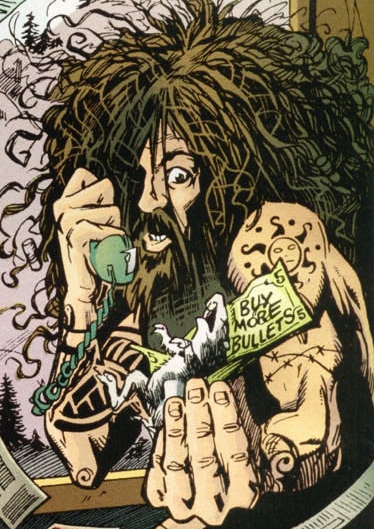
And then, there’s Spider himself, the upraised middle finger of our story.

Spider barely qualifies as an anti-hero, in that there is no purer motivation for him except to get back to isolation and seclusion. His dedication to self-pleasure through drugs and alcohol, his preference for independence, his abusiveness to everyone around him at all times, and his over-use of rape imagery in his language (which, if I’m perfectly honest, makes me uncomfortable every time it’s used) makes Spider questionable as someone to identify with at best, and morally reprehensible at worst.  He is an outsider in every sense, bound to no word or honor that the rest of the world accepts or acknowledges.  Coming to The City seems like more of an attempt to give the system one good solid kick in the nuts before he can disappear completely than it is an attempt to resolve any kind of owed debt to his publisher.  He is hardly a contestant for a 70 issue run of stories about his life, and is yet another barrier to entry that makes it hard to recommend the series who has anything close to a “delicate” sensibility.

So, if it is such an abomination to most pallets, why on earth write anything about it?  Isn’t this a “you either like it or you don’t” kind of binary?  Isn’t this Fight Club, or Lost all over again?  What more could there possibly be to say about a series so foul and difficult to get into?  To start with: the sense of humor.  If you like your comedy like you enjoy your coffee, Transmetropolitan delivers in this category in spades.  Granted, you have to be on-board with every permutation of filthy language, including the over use of words like Cunt and Rape and Fuck and every imaginable (and colorful) modifier.  Ellis & Robertson take to profanity like Peter Capaldi in The Thick Of It, and not just in language, but in visual and narrative depiction, too.  They love a good ribald joke, and to them, the funnier the filth, the better.  So, a crude-oil-choking-animals-stuck-in-plastic-rings-black sense of humor is a huge part of the interest for most readers.  But to me, even the jokes cover the more interesting bits.
 

spider1Let’s Get This Out Of The Way (Here There Be Spoilers)

To discuss Transmetropolitan with any more granularity requires spoilers, so I’ll just jump to the somewhat meaningless climax and get it over with: Spider types – in real time, mind you – a column so powerful that he stops an in-progress riot.

I shit you not; even in a Sci-Fi context, it is the primary definition of deus ex machina.  (Let’s see me “write” my way out of this one!)  But the plot in this particular story – like some of the best gonzo journalism – is more atmospheric than essential to what’s really going on.  It’s the tone, the conviction, the character study, the word painting, of putting your faith in something that is A Good Cause in spite of your worst personality traits, the TRUTH (or whatever) at any cost… it’s putting on the page some flavor of honesty in whatever form you can, be it journalistic or comic-book-ic. Robertson & Ellis both loose the story in one hamfisted detail or another along the way.  And with Back On The Street, they shoot the moon on the first try, which is admirable AND foolhardy.

And, to me, that is the point, too.

In the course of Back On The Street, we find out that Spider has sequestered himself “up a god damn mountain” in a rural part of the world, living with little communication for the last five years, lost in a drunken, drug-fueled solitude that he’s been quite enjoying, selfishly.  He is coaxed out of this reverie because he still owes an ex-publisher two books.  Spider returns to The City, where he obtains a columnist gig immediately based on his reputation, and his first story is following up on an old friend, Fred Christ, who leads the Transiet Movement.  (These are people who are transitioning from human to alien.)  Fred incites two of his people to start a riot to get some press about the way the transients are being oppressed. Spider covers the story live, forcing the cops (who are engaging in the riot) to stand down.  During the riot, Fred is found to be a fraud, rapist and pedophile, and Spider is beaten by the cops outside his own home to teach him a lesson about getting in the way of real power.  Spider joyously rises up from the ground in the last scene, laughing triumphantly, happy to be back on the job in The Glorious City.

Roll credits.

As a story, it’s not bad, and it was clearly enough for the publisher to get the ball rolling, and give Ellis & Robinson a series.  (It was just as likely that the series would forever be remembered for the three-issue run, too.)  But when you get to the next collected volume of comics in the series, you realize it it isn’t even the greatest Transmetropolitan story, let along a great beginning to a series that changes and evolved over time.  More than anything, Back On The Street reads like a foul-mouthed, pro-drug diatribe, a manifesto with plot holes and idiosyncratic views on government and politics that is somewhere between a comic series and Police Evidence.

However, when the series began to get collected in trades, we know that Spider became a bit of a phenomena all over.  Clearly, this book spoke to an audience that was being rewarded for looked for further meaning in the series, and it’s clear there is something else going on here than just a string of comic book profanity.  Ellis & Robertson are pointing their sci-fi barbed ideas directly at the current American Dream, and their commentary has only become more relevant as time has gone on, but was on the minds of everyone in the ’90’s.  The representation of journalism as a narcotic-inspired sprint from interview to interview, only so the publisher can participate in some devolved version of political discourse – in spite of what’s happening in a city overrun by vandalism, poverty and inequality – even at this far-future date of 2015 seems eerily on point for what is now almost a 30 year old series.  Throw other hot topics that are not even the main subject of the story – issues of trans culture, cult leaders, police brutality, and invasive species – and you’ve only sort of scratched the surface of what Transmetropolitan is all about, on one level.

Nobody comes out of Back On The Street looking good. Spider stops the riot, but is beaten for the effort. The trans movement gets press, but their spokesperson is revealed to be a sex-crazed pedophile who joined the movement to get tail and make money.  The police are clearly on the take, and easily manipulated, but this only makes them even more dangerous than originally intended.  Even Royce (Spider’s editor) goes from ‘doing Spider a solid’ to milking his popularity and brand as a way to make a lot of money.  As mentioned above, the book makes it hard to like the story through obscenity and other prickly presentations, and so if there is an appeal to the book, it must come from Spider’s personality.  Or rather, his resemblance to Hunter Thompson in behavior.  It is from this angle that the character – and the series – starts to come into intellectual focus.
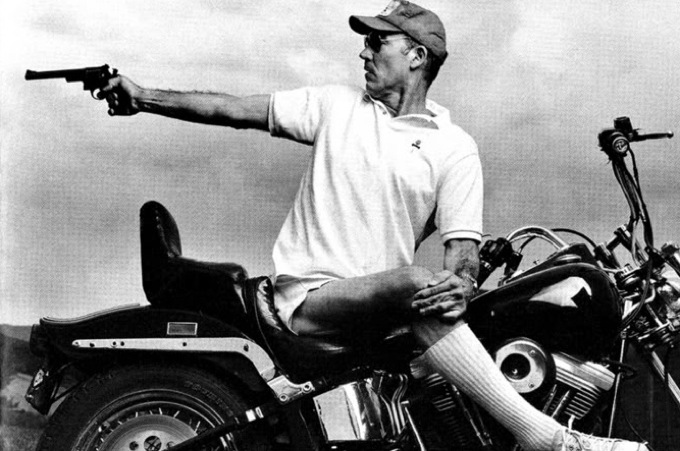
hunter-s-thompson-liebowitzTransmetropolitan is best summarized as a Sci-Fi depiction of a Hunter-like character in an undisclosed amount of time in the nearish future, and this has been the back-cover-blurb short-hand for what the series is about since its inception.  It is a summary that Ellis & Robertson have tried to shake, doggedly.  Still, it is a decent enough jumping on point if you are trying to find a way to pick up this series, and if you are not on board with that basic concept at first, it is likely nothing can attract someone who is wondering if they’ll like the book.  Admittedly, people may like Spider for the ways that he is different than Hunter: Spider is much more jovial, and seems to be having fun as a journalist, and seems to enjoy the physical benefits of the surreal insanity of this future world, unlike Thompson, who seemed to despise modernity in all its forms.  It seems that, rather than to use Hunter as a direct inspiration for our protagonist, they have inverted his archetype to distance Spider from this part of Hunter’s character.

This blurring of reality and fiction seems to be much closer to the goal Ellis and Robertson have with this book.  Spider Jerusalem.   Hunter Thompson.  Their names are structurally similar, and even some of the physicality in Spider’s appearance is obviously meant to evoke the comparison between the two characters.  But their personas are just different enough to create cognitive dissonance.  Ellis & Robertson are giving us all the cues to expect a Hunter analogue, and deliver to us instead a much more exaggerated (and “comically” humorous) version of that expectation.  As with all mysteries, Hunter is the McGuffin, but the the key to the mystery is still in the actual depiction of Spider.  Just not in the way you think.


I Will Not Let This Devolve Into A Discussion Of Shade The Changing Man: Coming From Meta 

The late ’90’s found a number of new styles, genres and authors rising to prominence as post-Grunge culture searched for their respective literary voices. The book that most resembles Transmetropolitan in form is The Invisibles by Grant Morsrison, which predates Transmetropolitan by a few years, yet they did run concurrently for a quite a while.  spider-morrison-king-mobKing Mob – the lead character of The Invisibles – is a dead ringer for not only Grant Morrison, but for Spider Jerusalem, coincidentally. (And, note the similarity in the form of their names, too.)  This makes perfect sense in meta-narrative way.  Spider’s look before moving to The City is a dead ringer for another, even older British author, Alan Moore.  Through this meta-lens we can start to understand what Ellis & Robertson were driving at with this layered and obtuse story.

alan-moore1spider-jerusalemIt goes without saying that Moore’s work on Swamp Thing & Watchmen (and, to an extent, his other DC work in the ’80’s) laid the groundwork for the ’90’s influx of UK talent.  His reputation was equally legendary for his intelligent comics stories and his dedication to sex magic.  His shamanistic appearance and tendency to incorporate poetry and blank verse as part of his narrative structure – and his larger use of literary collage as a well for inspiration – made him one of the first true auteurs of comics narrative writing. Many of his most well-known pieces of work were built upon his interest in borrowing characters, plot elements, genre conventions and song lyrics, all to assemble these parts into a dramatic story that was highly critical of power and government. The quality of the writing was of an intellectual caliber that exceeded what was prevalent in, say, the people who scripted, “Justice League,” to pick something at random.  When you looked at the typical superhero fare of the era side-by-side with Moore’s work, it was hard to argue that he was anything less than inspired.

Morrison – a much more ’90’s figure in the world of comics – is not only a sort of namesake descendant of Moore (Moore-son), but to chart his own territory, took a different approach to the comics world through drugs and meta-text, placing his own overlay onto Moore’s framework for creating the perfect post-modern comics statement. Morrison’s stories also tended to have borrowed elements, but his characters were from comics own history, and are often aware of their own fictional qualities.  Some of Morrison’s characters refer to themselves as “fiction suits” due to their physical similarity to Morrison himself, and these characters often make efforts to contact either the author or the reader directly, as the story demands. The Invisibles deconstructs spy narratives to the point of visual dissonance, and his runs on Doom Patrol and Animal Man defied both continuity and company policy in favor of post-modern jokes, and the search for the ‘creator / narrator.’ Morrison’s own theology seemed equally centered around hallucinogens in those days, but there is always an element of self-discovery and identity exploration at the core of his books. Trans lifestyles, government illogic, the inter-connectedness of all things all tend to work in concert with each other to create a non-linear, but impressive story.

Armed with this knowledge, the introduction of Spider’s character in Back On The Street suddenly carries with it a little more weight with it. As this bombastic and clearly educated character is up on the mountain, he leads a hermetic and drug-hazed lifestyle entirely focused on the self. Spider grows hair (that is usually eliminated by a normal shower in modern life). His attitude toward fans and the outside word is shoot-first, and his desire to have any public association with the work he’s done is nonexistent. However, his frustration with the world of publishing and modern life is not so strong that his book deal can’t draw him back to The City. The allure of writing a book on anything he chooses (once he writes the one about politics) awakens within him the need to pursue unfinished business. Each time Alan Moore agrees to work on a new book, it is not hard to imagine a similar phone call to the one Spider has at the beginning of Back On The Street.

Spider’s transformation into a Grant Morrison figure is made possible through the character of Royce, the managing editor of the paper. The role of editors in the world of comics plays a similar role to that of print journalism: take the writer’s material and massage it until it is ready for public consumption. Every book and major character at a comics publisher has an editor, and their role in making sure stories and titles get to the printer on time is not only necessary, but essential to coordinator with all the other writers and editors at a publisher. The shape of the final product, and the way we see the author that we read, is often the work of an editor.

Not to put too fine a point on it, but it might be worth it to include photos of Darrick & Warren to the images of Royce as depicted in Transmetropolitan. It is truly uncanny, and absolutely an intentional move. More directly a dead writer for Darrick (but also sharing a few of Ellis’ own visual cues), Royce is the filter through which the public is exposed to Spider Jerusalem. Royce keeps Spider’s ego – in its purest form – from reaching the audience, just like Stuart Moore at Helix Comics is the filter between the public and Warren & Darick’s raw vision for who Spider could truly be. (Stuart is referred to in the credits as “whorehopper,” a reference to the editor that holds Spider’s two-book contract, further blurring the fiction / reality border.) In just the drawings used to represent the main characters in the story, Transmetropolitan presents itself as pure metatext through using well-known comics writers to play out the drama. Once Transmetropolitan is read with a meta-text slant, the series really begins to reveal itself as something very masterful.

5: transitions.

Spider’s transition from an Alan Moore analog to a Grant Morrison analog is clearly meant to be seen as a cultural shift from one “older” paradigm to a younger, fresher one. Spider is moving from a purely creative position of integrity-in-art (Moore) to a position that must play the game, and learn to enjoy doing it (Morrision). On the mountain, Spider is merely a man, living alone, immersed in chemical abuse and the slow and steady detachment from the world around him in an almost spiritual pursuit of oblivion. Spider then traverses from the mountain to The City, where he is not only “plugged into” The City (as his devices come to life in the car as he gets closer, and can finally get a “signal”), but does so out of an obligation on the part of the writer to live near to where the publisher operates (a common practice in the old days of comics). But rather than work directly on his two-book contract, he instead starts an entirely new project with Royce, using the logic that he income from this new gig could help finance his work on the other contract that is due. (This is like the logic of using methadone to kick heroin.)

While we never see what Spider does on the mountain, its sounds as if he spent a lot of time in an altered state of mind, detached from the world. But when he comes to The City, he wants intelligence drugs, and the benefits of modern technology, to keep him focused on on point. His chemical intake shifts from oblivion to participation. Where Moore had become difficult to deal with, Morrison has become more and more dedicated to playing the game, a move that paid off in the long run. The style of dress is dramatically different, too. Spider wears old, worn and heavy clothes on the mountain, covering every inch of his body. It is somewhat funny, then, when Spider goes to his shitty apartment in The City, takes a “shower,” and it thus, baptized in light! He is reborn, now looking like Grant Morrison where he wears sleek, all-black “minimalist” clothes, where his form is easily revealed. Even his transition from the Mountain to The City is preceded by him blowing up the last remaining point of human contact he had before, and driving drunk into The City in a shitty car, barely acknowledging that he should be concerned about his behavior because he is ready to play the game.

The “two books” detail is interesting. Spider owes The Whorehopper a book about politics, and another of Spider’s choosing. This should be easy to Spider, who is not only a political journalist, but a prolific (and very famous) writer. But clearly this was difficult, so much so that he took the advance on this contract and retreated from society for five years to avoid writing either of these books, instead reading “Confederacy of Dunces” and “Fear And Loathing” over and over again. Spider has some sort of writer’s block, to a degree that is more severe than most. He not only can’t write, he is disillusioned with writing as a form of communication that can successfully change the world in a positive way. This problem is so pervasive that Spider can’t even muscle his way through a book on politics to get to the real gem, a book on any subject of his choosing. This can be seen as a metaphor for the book you have to do in comics to get a creator-owned deal, a common path for young writers, but also how things had worked out for both Ellis & Robertson, where Transmetropolitan was their “second” book.

6: Confusion between Referrer and Referent

The add to the ambiance of the world of Transmetropolitan, there is more than a bit of interplay between written bits that inhabit the world of Spider Jerusalem, and provide an additional level of commentary and meta-text to the book. The bar that Spider hangs out at is called “Bastard’s” (where they serve “Moore” beer). The rocket is branded “Eat Me,” and Spider’s license plate is alternately seen reading “Spider” and “Spyder.” The City is called City, and you can buy Exclaim Magazine! everywhere. Cop cars and taxi’s are easily identifiable, as their license plates read “Police” or “Taxi,” and the local paper is called “The Word,” and books are titled “Blah.” Signco produces all the signs in The City. The most popular brand of cigarettes are called “Stress Managers,” and all buildings are outfitted with AirCo brand air conditioners. Spider wears boots branded “Stomp,” and one man drinks a “Fuck You” brand liquor, straight from a bottle. The local strip club is called “Bazooms,” and you can get money from their “Cash” brand ATM. In a nod to Repo Man, beer is “A Can of Swill.” Computers tell you what they’re doing by printing “On” or “Recording” on their screens, and stairs are labeled with the place they lead to on their signs.

This language is difficult to classify in Transmet. They are not graffiti, not sounds effects, not dialog, and most likely, not meant to be “real.” Rather, these are all tiny jabs and barbs, little commentaries on how linguistic or world has become, but also to emphasize the symbolic nature of the item itself, in a medium already prone to meta-text. A police car with the license plate “Police” is too exaggerated and on the nose for most comics. But this book is trying to blur the line between reality and fiction anyway, and it makes sense that the world would just use these kinds of shorthands to continue that slide. Spider’s own view of the universe seems to be permeating the images we see, so much so that his reductionist perspective, he’s fleeting commentary, and his disdain are all captured in these kinds of uses of text.

7: The Message Behind The Meaning

Ellis & Robinson are fairly casual when it comes to referring to the social, political and ecological problems that plague Spider’s universe. In many ways, the problems are largely irrelevant, and only occasionally push their way into the narrative forefront. However, what is unique about these references is that, in the hands of most other Sci-Fi authors, the entire story would be subsumed in these secondary (and tertiary) references that liter the story in Transmetropolitan. There seems to be little to no control over guns, as they are everywhere, used liberally, and with seemingly no consequences. (Spider has a rocket launcher and grenades that are used often.) Traffic is not only a continuing problem in the future, but there are actual standstill days where people like Spider just get up, abandon their cars, and walk. Advertising is ubiquitous and on every surface imaginable, in every size, blocking any and all skylines The City every used to have. Geckos are an invasive species that has become an incredible problem in The City, so much so that mutant feral cats have been genetically altered to hunt and eat only Geckos. Every home is equipped with a “Godti” maker, that can materialize our every need. The only problem is the machines often get hooked on drugs.

Glossed over quickly in the first three issues: Trans Culture, Drug Abuse, Ghettos of the Future, Cult Leaders, Rape, Child Abuse, Cameras Invading Every Last Privacy, Age Restrictions In Bars Lowered to 17, Ridiculous Future Fashion, Police Brutality, Bar Codes Replacing a Stripper’s Nipples, Journalistic Integrity vs. Journalistic Terrorism, and the continuing slide of human apathy. And all of this – and more that I missed, I’m sure – are crammed into three issues. The denseness of what is happening in every panel of Spider’s world is directly connected to his hatred of life in The City. He curses the moment all of his “devices” activate as he gets closer to The City, and he becomes a distracted and ferocious driver. The sound of The City makes him question his return, and speaks to the tangle of issues that Spider can’t completely engage when he is forced to face them head-on.

These is clearest when Spider meets up with his soon-to-be editor, Royce. When they are together, they yell and scream and smoke and swear for most of the interaction, but when Royce corners Spider – Editor to Writer – and asks why Spider left, and while he points a gun at Royce’s forehead, says, “The fans, Royce. The fans and the noise and the bullshit and… I couldn’t get at the truth anymore,” to which Spider puts down the gun, for one brief second, absolutely vulnerable.

This is the most precise interpretation of the creative process I’ve ever seen portrayed in comics: you’re manic creative side violently rebelling against the organized editor only because you’re insecure about how honest your work actually is. It is really the only time you see Spider emote earnestly, and only when he’s concerned about being a fraud. It not only offers another dimension to his character, but also seems to be a bit of a plea on the part of the authors: we’re going to strip things down, bare, in an effort to be as honest as possible. But to do so, we’re going to have to make light of some social issues. We’re gonna use course language. But this is all metaphor, a way to analyze the creative process, creatively. Let me take my guard down for a moment, and maybe we can go on a journey together?

Spider and Royce and a fascinating relationship. Royce begins every conversation with, “Where’s my fucking column?” in spite of the fact that it is only two hours after he hired Spider to write for him. Of course, Ellis & Robinson can’t resist a bathroom joke if they can help it, so at this point in the story, Spider is on Jumpstart, and has taken to keeping the phone in the toilet bowl (since he doesn’t use the bowl anyway, and since this location reflects how he feels about the phone, since only Royce can call him anyway). Spider furthers by asking his adopted gecko-eating cat to piss on the receiver in lieu (hold for laugh) of a proper hang up. The scene is played for laughs, but this is just after Spider has cleaned himself up, and is looking for a story to write. Spider is constipated in more ways than one, and in spite of trying, he has yet to write a single word.

8:

In yet another turn of inappropriate humor, Ellis and Robinson decided that the climax of Back On The Street happens on the roof of a strip club, while strippers watch Spider – ahem – pull off a live story while he watches a riot. It makes sense that Spider feels at home at a strip club, as he sees his own work as prostitituion, and finds no problem with that lifestyle for anyone. The metaphor continues as Royce watches Spider’s live-feed coverage of the riot, and Royce’s eyes glaze over, as if he’s watching porn. Royce immediately monetizes what Spider is doing on the live-feed, pimping out Spider’s words like anyone else does.

But what makes this scene incredible – and appropriate to our discussion at hand – is the way in which Spider is depicted in the panels where he is “live blogging.” Spider’s face contorts into every possible facial expression: joy, anger, bemusement, epiphany, sweaty-clenched teeth, half-closed eyes as smoke snorts out his nose, so into the moment that he is barely aware that the riot has “climaxed,” and shut itself down, while he is still pounding away on the keyboard, lost in the moment of textual release. Afterward, exhausted and with a sad-but-spent expression, he passes out in the open hand of a hooker. Or, at least, the sign outside the strip-club designed to look like one. As the police leave the scene of the riot, Spider remarks that, “they’re pulling right out.” More telling, the stripper refers to Spider as “fuckhead.” He’s not having actual sex. He’s fucking “in the head.”

Bedroom humor aside, the point is made that Spider walks past all four strippers (who don’t seem to do much for him), and is much more turned on by his relationship to the written word. To him, it is the drug, the thing that gives him a mainline jolt, and fills him with horror and humor and joy and desire. In this section, we are given the whole of Spider’s Id in all of its playful, graphic, privileged wonder. In a lot of ways, what is printed here is irrelevant, and I went through it a few times for pull-outs or lines I could use to sway my position. But, ironically, they only paint a picture of Spider, not the event at hand. The “live blogging” plays a role in the plot, to be sure. (The police leave because of it.) But what is blogged is lost, and instead what is revealed is that Spider’s only joy, his only release in this world is writing what he sees around him, as honestly and as directly as possible, and only then will he feel any respite from the nagging problems of everyday life.

This, of course, is at the center of the Ellis – Robinson thrust of Transmetropolitan. The meta-text and inside-comics-baseball structure of the story – and the way in which every moment can be pulled apart for a layered commentary on writing, and specifically Sci-Fi-gonzo journalism – is a mission statement from the creators to offer up a perfect cross-section of what the book will be about for the next 67 issues. Ellis and Robinson are interested in the struggles of The Writer. The work they produce. The relevance they serve. And what about Comics? Can it get political? Can it be “gonzo”? Ellis and Robinson want to get as close to the metal as possible, and this means taking their stories through multi-layered bathroom and masturbation jokes, by turning environmental shortcomings into one-off jokes. They want the writer to be the main character, to focus on his problems and difficulties. Who hasn’t felt, at that moment of creation, like the smoking and snorting Spider from the climax of Back On The Street?  Only, later, to realize you’re just a guy, drunk and watching the world, and trying hard to reflect into text how you feel about it.

9:

It is easy to sell short Transmetropolitan for the shortcomings. It is very ’90’s, in style and presentation, and while Spider seems righteous, he can wear on your nerves, absolutely. But to dwell on Spider as a character sort of misses the point. This is a study in writing – about what writing can do, where it can go, and what it can tell us. This is a study in form, both comics and journalism, contextualized through the tropes and ideas of Sci-Fi. This is an attempt to see if this kind of writing can be done, and to break it down as the series progresses. Spider is, in many ways, secondary, because at the center of Transmetropolitan is a love-letter to pitfalls of the creative process, and that is the greatest strength of this book.

The humor, the art, and the large upraised middle finger to all expectations and conventions are merely icing on the cake.

Spider lives on the 1600 block,

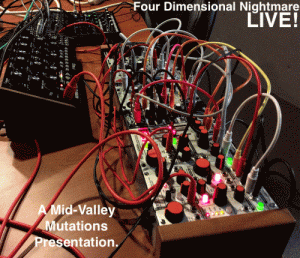
Are you ready for a Four Dimensional Nightmare, LIVE! Over 30 minutes of live electronic music on Mid-Valley Mutations, and plenty of other rare and unreleased music by this unusual Northwest Artist. Available for stream or download. Enjoy!

Four Dimensional Nightmare, LIVE! (#28)


NANOWRIMO Wrap-Up

untitledI first heard about NANOWRIMO in 2004, and in 2005 I decided that I was going to compete.  While I didn’t do it every year, it wasn’t until 2015 that I actually completed the expressed goal of writing 50,000 words toward one story in 30 days.  Let’s process that for a moment.  10 years.  Usually, when I fail at something for 10 years, I just stop trying entirely.  I guess that’s what Writing does to you; you become an addict, constantly looking for the next rush.

It is true that I have always loved writing personally, and that I usually opt to do that if I can.  But NANOWRIMO is a bigger challenge than writing a ‘zine, and much more demanding than knocking out a short story on the weekends, when there’s not much else going on and there’s no deadline.  For all of those wannabe writers who love to talk about the craft and how they are in love with the written word, there is something about having to produce that much material in that short a period of time, that really forces you to work close to the metal.  There are no do-overs.  On December 1st, you do a total word count, and hope that you got there with all that blubber you added at the last second.

In 2015, I had a number of factors working for me, and I started very strong with my novel, with the very-high expectation of writing 2000 words a day.  This worked great at first, but between technical challenges, a computer crash, and majorly loosing steam half-way through, I missed several days, where I couldn’t write a single word.  I caught up quickly, and when I limped across the finish line with a few days left to spare, I just quit completely, and didn’t write anything those last few days, in spite of trying.  While I technically finished, I felt a little lame about the way I finished, especially since I did this publicly; not only were chunks of the book being serialized on this very blog, but I was allowing people to read the Google Doc where the story lived at any time, and published that link all over.  (It might even still be available, buried somewhere in the avalanche of other stuff that’s online.)  Anyway, there was something about the public nature of the project last year that really made me feel bad about the way it ended.  I should have finished a little more gracefully, but so it goes.

I approached the process of writing a story like this very differently last year, too.  In the past, I would start at word one on page one, and would try to build the story from there.  It was sort of painstaking, as a friend of mine used to say, the “Ice Skating” approach to writing.  (Get it right in the first pass, and that’s it.)  If you don’t know what the next word is, well, you wait until you do.  And you hope that inspiration will guide you.  For my 2015 attempt, unlike all previous efforts at writing, I spent the first couple of days assembling a detailed outline.  All of these outline words counted toward the total 50,000, and as the month progressed, I would highlight a couple of words from the outline, and flesh it out into the scene that was described.

On the whole, it worked, and it allowed me to do something that I’d never done before: write something out-of-sequence.  Humorously enough, I almost never did.  Usually, I would look at the outline and work on the next section.  When I got stuck, I went back a couple of times to flesh out spots that seemed weak in hindsight.  But I rarely went forward.  I just had no idea how to do that.

For 2016, I more or less forgot that NANOWRIMO was coming, and really only decided to do it at the last minute.  There are a number of personal factors that informed this, but when it looked like I had time on November 1st, and an idea occurred to me, I ran with it.

Like last time, I decided to start with an outline.  Like last time, I set a goal of 2000 words a day.  And like last year – and in previous years – I ran with a detective story, too.

But, when it came to the actual writing and day-to-day aspect of it, this year felt very different.  There was a sort of confidence up front that I didn’t remember from last year.  Having completed it before, it now seemed manageable.  Like I’ve heard many people say about honing any skill, once they achieve something once, they know it is possible.  Doing it again is just a formality.  So even on days when I didn’t hit my goal, or even didn’t write anything, it never felt desperate.  I’d already had the worst happen to me: complete computer crash in the middle of a novel.  And in the end, we recovered.  It wasn’t even mildly awful.  If that’s the worst that can happen, then what did I have to fear this year?

Another first for me this time was that I wrote things well out of order.  This was quite practical at first; sometimes, I just didn’t know how to flesh out a scene, and it made sense to write some bantering dialog.  For a good part of the beginning, I wrote a ton of backstory, so I would have some reference material to inform the main plot.  It wasn’t until I’d spent almost five or six days on the backstory that key plot points started to come together in my mind.  Writing out of order also helped me realize that there were huge sections of my outline that were unnecessary when I reviewed everything, and now sections of the story have these weird dead-end sections that sort of go nowhere, because I realized that set-up was no longer necessary.

In fact, when I review the results of this year’s efforts, it is largely unreadable on December 1st, and this is very different from previous attempts.  I will not be serializing this anytime soon, and I’m not sharing the link, either.  But, there is a the seed of a story in there, somewhere.  I could imagine, given a long enough timeline, that I could whip this into shape.  But for now, the idea of returning to this monstrosity just seems inhumane.  It is a huge, sprawling, messy and largely nonsensical detective yarn, and even by that standard, would be hard to enjoy, offers little closure, and is not a good example of what I can at my best.

To make matters worse, I actually got a writing gig in November of this year, which meant that I had to crank our three non-fiction stories during the bulk of NANOWRIMO.  Not only did I have to put the brakes on my “novel” to do my newly-acquired job, but it sort of took over a lot of my brain-space, too.  You don’t realize how many processes are working in the background to come up with words, that it is only when you need to split that time across two project that you realize how exhausting that process is.  You are just wiped out.  In this respect, and in this respect alone, I cheated; the work I had to write for this new job was added to the total word count for November writing.  While I did come up with an in-story reason for this, and I don’t feel guilty in the slightest for doing it, I do feel like I need to mention this caveat.  I absolutely wrote a ton in November.  But not all of it was strictly for this novel.  (But, you never know, considering one of the characters is a journalist / zine writer, it fits, right?)

Another difference this year was location; I wrote this novel in a number of places throughout the month.  It’s sort of hard not to, what with the holidays and etc.  But technology makes stuff like this so incredibly easy, and by using a Google Doc, I never lost a word, no matter where I was writing.  However, this didn’t prevent me from experiencing writer’s block.  When I was not in my two primary writing environments – the office or my home – it was so much more difficult to put my butt in the chair and start churning out words, that there were many days I wrote nothing.  Never had the environmental factor become so apparent to me, and now I had evidence to back it up.  I write better in my natural environments.

Because I missed a lot of days this year, even my 2000 words a day goal couldn’t cover for the days I wrote nothing.  This led to something I had never done before, and turned out to the most exhausting thing I’ve ever done while writing: churning out 4000 words a day, or more, in order to catch up near the end.  On no less than six occasions I wrote well over 2000 words, and three of those were in the 4000+ range.  (One day was nearly 7000 words, even.)  Those six days were… terrible.  There’s just no way to sugar coat it.  Not only did the words get worse as the day progressed, but those were tiring days.  To my knowledge, I’ve never written that much in one day before, and to think that I did it this year still seems insane.  I should know better.  While I finished the projected goal by the end of the month, there were a few days where I felt physically exhausted, just from coming up with words.

On the whole, I had a great time this year, because I feel like I learned a lot of practical lessons about writing that, while perhaps obvious, are things I need to continue to keep in mind to continue this journey of becoming a writer.  Never have I felt that there was so much to learn, and at the same time, never have I felt I have made such progress.  While I’ve tried to condense this into a handful of tips to close out this reflection, I should preface this by saying that it has taken me 20 years of writing and 10 years of failing at NANOWRIMO to make these realizations about myself.  While useful to me now, please don’t assume this is across-the-board advice that will work for everyone.  Just a few observations about how I work when I’m writing.

Hopefully, this will help you find what works for you.


10 Writing Tips Learned From NANOWRIMO 2016

1.) It’s About Words; Nothing More.  There is a time for making every sentence unique, making every simile perfect, and having continuity between the entire body of work.  This is not that time.  Just write.  A lot.  Let the words flow.  Let your sentences be clunky.  Let it all out.  Much later, you can fix anything you don’t like.  But for now, just get words down.  Lots and lots of words.

2.) Set Very High Goals.  To beat NANOWRIMO, you need to write at least 1667 words a day.  Write 2000 a day.  If you can, write even more.  Over-shooting the goal early, when you’re just getting started and you’re excited, can save you when you have trouble later, and you need a cushion – for whatever reason.  If you can write for a week straight hitting that higher goal, you’ll have plenty of wiggle room when Thanksgiving hits and you are too full to write.

3.) You Are Over-Thinking It.  Usually, anyway.  All of the best moments of my story are unplanned, and all the parts I want to save in future revisions are the things that I just threw in suddenly, without thinking about it.  When I would agonize over something, it would get worse and worse, and the more I would work on it to get it “just right,” the more time I wasted not-writing, because I was “thinking.”  You will have plenty of time to think about the story when it is done, and you can revise the hell out of it later.  But right now, stop thinking.  Start writing.

4.) Stop Being Precious.  This is something we could all work on.  In the end, this writing is not important.  There is nothing special or unique about your ability to sit down and write for hours a day, except that it speaks to your privilege, in that you are able to do that.  It isn’t true that you write better in one take, or when drunk, or whatever it is that you think makes you a better writer.  What makes you a better writer is to write, a lot, and to take it as read that you will be revising it all in the future.  What you write isn’t a perfect snowflake the first try.  This is just a mess of words that could be something in the future, if you let it.  But it can’t be anything if you aren’t able to just sit down and start writing.  Stop making excuses.  If you are a writer, then, by all means, write.

5.) Location, Location, Location.  It has been said by people more well spoken than I, so I will merely repeat: it is worth it to spend some time creating an environment you want to write in BEFORE you have to start writing.  My office and home are perfectly established places, where I can work and feel good about it.  Unless you thrive in places that are unfamiliar to you, I suggest making sure you have a few places ready that are comfortable, inviting, and induce as much positive energy as you can muster.  You will need it.

6.) Start Early, Work Late.  If you can, start writing in the morning.  Write as much as you can, and keep adding to that number as the day progresses.  If you can, write as late into the day as you can.  Every minute you are not writing are words that you can’t get back, so the sooner you start, the sooner you will get done.

7.) Track Your Numbers As You Go.  Spend some time creating a document where you can track your progress, so you can see how much you have written, and how much more you have to go.  I found that using a Spreadsheet offers the largest number of ways you can manipulate your data, and you can fine-tune it to give you exactly the kind of information you are looking for.  Obviously you want the grand total, but I like being able to look at the work finished each day, and how much I have to write each remaining day to hit the goal.  I recommend learning the key commands that offer your total word count, so you don’t have to use menus or look it up each time.  Seeing your progress in real time can help motivate you to stay on top of your goals, and keep working when you are running out of steam.

8.) Learn To Accept Failure Early, And Often.  There will be days when you just don’t write well.  There will be days you don’t hit the goal.  You might not even finish at the end of the month.  Or, you might, but your story will be crap.  Going into NANOWRIMO is ultimately an experience in coping with failure, because even if you finish, the story you have written will not be the breakthrough success that will make you a star.  Most likely, you spent a lot of time on something that you will not be compensated for, in any way.  That is fine.  Like accepting criticism, or having to accept what you can’t do, writing is not always something you will succeed at, even if you are good.  Learn to sit with that.  Find a way to feel okay with it, and move on.  You will need to if you want to hit 50,000.

9.) Take Breaks. It seems strange, but when you are in the zone, and you are writing well, the last thing you want to do is take a break.  But after even an hour, writing can wear you out, and if you are hungry, or distracted, or tired, it will be harder and harder to write.  Take as many breaks as you need, go for a walk, or whatever.  You will find even a few minutes away will not only help you feel like you can write longer, but will often give you new ideas that don’t come to you while you are actively writing.  Breaks are like the rest in a musical performance; learn to value them as much as the parts where you are writing at full steam.

10.) Get Ready For Post-Novel Depression.  This sounds silly, but I absolutely get depressed when I finish a project.  Nothing dramatic or even dangerous, but completing something is almost like giving birth.  Afterward, you feel like you’ve lost something.  And you have, in a way; a huge story has been created from words you put down.  All of that is out of your head, and while it can be relieving to get things out, it can also make you feel a little empty, in a way.  Fortunately, NANOWRIMO ends with the holiday season in full swing, and hopefully there’s enough going on to help give you some focus and purpose as you cope.  (Or, conversely, this is the most depressing time of the year for you, and you might need some help staying upbeat as you enter it.)  Either way, get ready for it.  This is just a sign that you need to recharge your creative batteries, and do some non-writing things for a while.  You’ve put in a lot of work in a short period of time.  If you want to be able to do it again someday, you’ll need to give yourself the recovery necessary to get back to full strength.  In the meantime, I suggest picking a new TV Show, letting yourself gain a few pounds, and re-doubling your efforts to spend time with friends (or, if you aren’t depressed by the holidays, with your family).  Not only is it the right time of year for it, but you’ll find recovery is so much better with people you care about.

Looking In All The Right Places: White Shark Shivers, Porest & Sir Richard Bishop at Turn! Turn! Turn! (26 November 2016)

There is a long history of you and your friends piling into a car and driving well into the night in order to catch a show that is not coming to your home town.  While the traveling performer is a very old trope in our world, it is only with the advent of national radio – where audiences could get to know artists before they ever made it to the town they play in – that listeners were in a position to know what a show might be like before they went.  Of course, by then the lines of communication were open so you could promote shows like this, and suddenly, all the pieces were in place to develop a culture where not only space could prevent you from seeing something you want, provided you could get there in time.

A much more modern tradition revolves around the weekend after Thanksgiving.  As people are visiting family and friends for that holiday, they are usually casting around for something to do on the days leading back to that Monday, when you return to work.  Bars fill up and, if you’re lucky, a few bands will tune up in the corner to help pass the time.  The folks at Turn! Turn! Turn! certainly had that in mind this year, and to that end, a select handful of us found ourselves huddled around a brand new stage as we took in one of these shows, bolstered by booze and food and a sense that, for whatever reason, this was what we wanted to be doing instead of standing around the kitchen as we cast around for the last few things we’ll be saying to each other before we go home tomorrow.

hjmxi8y8ynsrqbebpjmkuconzyof883xusgvtawb4d9ic_soj7cclbn5wn6jsimjfofztuovpzjjq85rbn9qk-r1zhcoqmvjmq2jis635jut2l3it65_o7nrlrqlij1hk2aqgpfzzpckuttwvt4vx5p9dsxrlydb4yyg3syocfjahvuaiqfv3sa_yu6guikqe4b_wyvWhite Shark Shivers started the show, an ensemble born out of various Thinking Feller’s Union Local 282 projects, with a large horn section and two guitar players, delivering something that had some of the same spirit as that long lost band, while creating a much more specific tone and mood that is not only more appropriate for a gloomy, raining evening, but felt in line with the current national mood.  While this seems to be an extension of Mark Davies’ 1994 solo project The White Shark – and the set certainly included some of those songs amid some covers and originals – this seemed like a new ensemble made up of old friends that is capable of so much more.  If we can’t have the Feller’s back, White Shark Shivers is absolutely the next best thing.

yokvbx1pqfpq4emq9rd2astju8zol6y6gh0u8nxtp8b-lbmfyf7hxnhswlndex5nujynmoczn7yiblvj_wyrrwcxqvtwzzhrffm1cbqc4ndord56qkxgj2cy7l8dua4y10hvudkrfljjbibac_m6cdkhvu8jcsdj5lsd__zygwfvja1ibgwnpdz29gchnldjdxxoy-iCompared to the crowd on stage for the first act, Porest’s two members was certainly an interesting juxtaposition, to say the least.  Having not played in the US for almost 10 years, this was one of two shows that were happening on this continent, and when you listen to some of the songs Porest is known for, it actually makes sense.  While mining some of the collage / experimental territory that Negativland loves to explore, Porest takes their political tone and runs wild with it, intermixing comedy and collage with deconstructive lyrics that might explain why Mark Gergis has been living outside of the country in recent years.  “Soapbox Cutter” is a scathing indictment of US policy and politics, delivered from his “karaoke soapbox” that so conveniently is the form of his stage show, “Diplomat Smile” continues to explore these themes, in a way that pre-saged the recent election, and yet seems to be commenting upon it, too.  “Keep fighting the fight,” seems even more ironic, and yet hopeful, when delivered to a crowd of dancing, happy fans.  Mix this with some on-stage destruction, comedy, and slick dance moves that accompany a song against smoking, and it was most certainly worth it to catch this rare artist in his natural environment.

f8ol_hdpflgycidxcnnruhzycj4gmzcmcts8xpon8tsdfk2b_fgkf6gn4tmq5w0xafiypcifzqhwddupgccsiny0g4a2vuszpewk1nwlxbvr-7jxlofizzel9u3nbhml39ftzc3r_pptqijurhjpwd2dupdomuyhd7vd6wecp5f8x7_mj2rhwzufhkhvpoefdyxo9tuTo close the show, Sir Richard Bishop of The Sun City Girls took the stage, and amid protests that we’d already seen the best, and that he was far too wasted to play well, he continued to deliver acoustic originals and covers that felt celebratory in a way we all desperately needed.  While his improvisational sonic explorations are always contemplative, he wasn’t beneath throwing in a few jokey covers like “Fly By Night” and an incredibly earnest version of “If I Only Had A Brain.”  We swayed, we rocked, we laughed and we cajoled, but it was mostly because we didn’t want it to end.  We still had an hour drive home ahead of us, and the liquor soaked joy and pot-tinged celebrations seemed to be just starting as Richard insisted that we had already gotten our money’s worth.

But as we blasted back down I-5 to return home, it seemed the perfect endcap to an incredible evening.  If seeing them, as Richard insisted, was about getting our money’s worth, then he’s being incredibly disingenuous.  Porest didn’t come to this country just to play for a small crowd in Portland for the money, and it seems odd that Mark Davies would assemble a group like his because there was certainly money in it.  Rather, this was another one of his jokes.  When it comes to shows like this, none of us are getting together in a small club because it is “worth it.”  Rather, we’re coming for the comradery, we’re coming to get away from our families for a few minutes and enjoy ourselves.  We’re looking for something else in the night, in the rain, in the darkness, in this November at the end of a year that has beaten us down, insulted us, degraded us, and made us feel like there is no hope.

We’re looking, for a few hours, for some music.  And, fortunately, we found it.


A Sequel, And A New Beginning

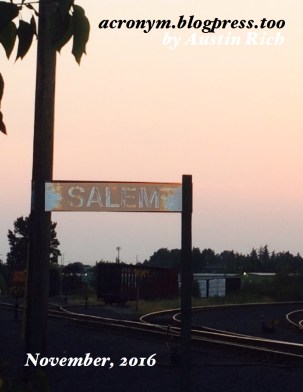
untitledacronym.blogpress.too

A new publication, with a new story.

And a pseudo-sequel to our previous endeavor.

Film & music reviews.

A chapter from the latest Dexter Roland yarn.

Photography by Austin Rich.

All in monochromatic glory, available physically, or digitally.

Our first run of both digital and print editions come with our previous effort, free.

Free, or you can make a donation in the amount of your choice to austinrich@gmail.com, via PayPal.

Dot Too.  Something New.


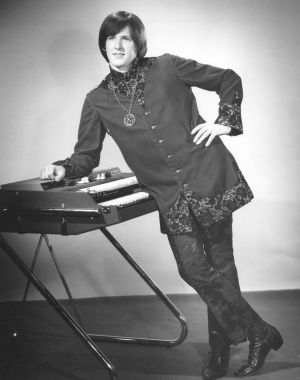
“Gerald Roslie posed on September 26, 1968, casually leaning on his Vox Continental electronic organ. He was wearing a Nehru-styled jacket with brocade trim, coordinating brocade slacks, black ankle boots and a scorpion medallion. Billed as the “Gerry Roslie Riot,” in September of 1968 he was appearing nightly and on Saturday nights in the newly remodeled Mod Room in Scotty’s, 29 Tacoma Avenue North. Roslie had been a member of the local rock group, the Sonics, for a number of years in the early ’60s. Although the Sonics played classic songs by Little Richard and Chuck Berry, they were better known for originals “Strychnine,” “Witch,” and “Psycho,” performed at ear-shattering levels. Roslie was the lead singer and keyboardist for several of their biggest hits.”


23 Seconds

23sotv13_cover72I am thrilled and honored to have a piece I made be included on this incredible compilation, 23 Seconds ov Time – Volume 13.

I appear on the 16th track, and my piece is called “Rocket Summer.”  Mid-Valley Mutations fans may recognize the sample from The Martian Chronicles episode, but repurposed differently for this song.

There’s some choice experimental artists among the 53 who contributed to this collection, including friend of the show Uneasy Chairs, who kicks off this comp, and Blue Sabbath Black Cheer, who are incredible.  I’m very pleased that they used my submission and I’m very proud to be included with so many other great artists.

The album is free, and if you like experimental music, this is a must have.

And there are 12 other volumes available, too.  Collect them all.

WTBC New Releases

a1590049298_16We have been doing our best to provide as much quality entertainment as possible on the shoe-string budget that is best suited to these modern times, and with that in mind, we have completely updated our Bandcamp.com Store with new and exciting releases that are of interest to you.

In the period before I began at KMUZ, I was doing a show on an Internet station, Wanting To Be Cool In Beautiful Anywhere, Anywhen.  While they became a very comforting home to me and my work when I was not on broadcast radio, in the time since they have become dedicated to documenting the work we’re doing, and capturing some of the performances that happen on our program.

To that end, there are now downloadable versions of the live performances and interviews we have had on Mid-Valley Mutations, where you can enjoy bespoke digital albums of each act, without the clutter of the rest of the broadcast that you have come to know and love.  The albums contain full performances by the artist we’ve had on the show, and in a few cases, material you haven’t yet heard!

fiascoOur store now contains:

The collaboration between myself and devilsclub entitled “Beware of Tomorrow!

Two complete live sets by Guyve, including a lot of material that could not fit into the hour long show!

The Digital FM Split Tape!  (Featuring live performances by Entresol & Entrail, including 15 minutes of music between the two of them that did not air during the boradcast!)

msdA nearly 51 minute performance by Portland Improvisational Mavericks, Fiasco!

And a manic, Pledge Drive Performance by Manual Sex Drive.

All of these albums are free to enjoy and download, for the time being.  This is your chance to pick up a ton of excellent recordings that are unique to Mid-Valley Mutations.  However, if you are so inclined, please make a donation for all of this excellent entertainment.  Any purchases you do make will go to supporting KMUZ, and keeping that station on the air.

In addition to these, you can also pick up Interviews, which contains 13 different interviews with artists who have been on the program.  These are extended conversations with musicians about the work of creativity and music in the 21st Century, and offer a chance to get to know the people we play on the program.  You will not hear these conversations anywhere else, and it’s just another way we like to give back to the listeners at home.

There are also a number of other audio treasures over there, so poke around and see if you find something you like.  We hope that you won’t be sorry.

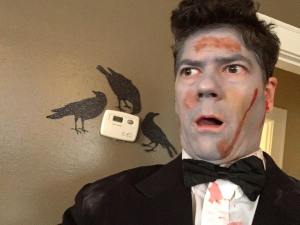
Halloween Spook-tacular, 2016!

img_20141025_110248While not the production it was last year, I wanted to quickly mention that we are celebrating Halloween the old fashioned way, and yes, that involves your podcast feed.

Mid-Valley Mutations is offering bonus episodes on Mondays and Wednesdays of October, for a total of 13 Holiday podcasts.  Four of these shows will air on KMUZ, as the shows do normally.  (10 PM, Friday nights.)  But there are nine gems, hand picked from our 13 years of producing Halloween Radio.  This is a chance to hear the many permutations our program has perpetrated, and gives you ample bonus material for that impending holiday party.

You can find all of our holiday entertainment using this handy link: midvalleymutations.com/category/halloween-spook-tacular

Or by enjoying the podcast feed, available in all your local podcatchers of choice.

Happy Holidays, from us, and Mid-Valley Mutations.

Be Seeing You.

#thankful4KMUZ: Here’s How You Can Show It

cropped-KMUZWebHeader_2015A#thankful4KMUZ: Here’s How You Can Show It

KMUZ, like many radio stations depends on listener contributions to continue generate excellent programming.  When you make a donation to our station, you are showing how #thankful4KMUZ you actually are, by contributing to a cause that is now been on the air for five years.  You can make a donation by going to kmuz.org and following the PayPal links, or by calling 503-990-6601 starting tomorrow – October 1st – and pledging your support to our station – all the way to October 7th.

As part of our usual Pledge Drive, anyone who donates $50 will receive a black KMUZ Mug.  Drink coffee in style, and show your support for your favorite community radio station.

temp-coverFor listeners of Mid-Valley Mutations, we like to sweeten the deal.  For anyone who makes a donation of any amount to KMUZ, we will give them a digital copy of our new album, Mid-Valley Mutations Vol. 1.  This is a collection of some of the live moments from our program since May of this year.  This includes live performances by Paco Jones, devils/club, Guyve, Entresol, Entrail & Fiasco, a fine gathering of artists that have all contributed to this program.  And all you have to do is make any kind of donation you KMUZ you can afford.  I will e-mail you your digital album as a thank you gift for listening to the show.

a1714948314_16For contributions of $25 or more, you will get to choose from one of three gifts, curtesy of Personal Archives, No Part Of It & WTBC: Wanting To Be Cool In Beautiful Anywhere, Anywhen, including albums by Thollem, Bob Bucko Jr.Sex Funeral, Illusion of SafetyArvo Zylo / Dental Work and physical copies of The Shindig Shakedown, a gift that was largely available at Austin’s 40th Birthday Party.

For a contribution of $35 or more, you will get a vinyl copy of the Blood Rhythms Assembly LP, with a hand-made cover.  There is a limited number of this LP, so please make your contribution soon.

I could go on and on about how important these Pledge Drives are, so let me just say a few more words.  Without listener donations, KMUZ may have trouble paying the rent in the future.  We would not only loose all the great shows, but the physical space we use to make all of this happen.  This is why we need your money.  Radio is loose ground every day, and for us to have made it five years is quite impressive.  But to make it much longer, we’ll need money, and we’ll need your support.

If everyone who listens to my program were to contribute even $5, that would be enough to keep Mid-Valley Mutations and KMUZ on the air.  Let’s hope that we can raise that much – and more.  Make your donation now, and mention that you would like to support Mid-Valley Mutations (and which perk you are interested in).  Let’s make radio in the mid-valley powerful again.


Hot Eugene Nights

For your entertainment: a selections of videos that I shot while I was in Eugene, OR last weekend, from three different groups playing over two days.  Six videos, from Jason’s Campfire Punk, The Nervous & /root_DIR.

Enjoy

Felled By Illness.

imgresThere is no amount of technology or improvement in our culture or way of life that can erase how helpless and meaningless everything seems when we get sick.  There are moments, when we are awake at two AM, delirious, confused, feeling gross and insane, and your mind travels down a repetitive loop of nonsense that is both impossible to focus on and your entire reality – moments like that, where you suddenly remember how debilitating even the smallest illnesses can be, and how when someone says they aren’t feeling well, what, exactly, that can mean.

I felt it coming on Saturday morning, and while I wasn’t exactly sure at first, by the time we had decided what we wanted to do that day and were out in the world doing it, I was sure that the rest of my day would be awful.  We finished our errands, got home, and I went to bed, and have failed to get sleep ever since.  I’m sure I have dozed off for an hour or so, but nothing truly restful, or substantive.  I’ve spent a fair amount of time in the bathroom – and I will not give any detail as to why – and while I am often hungry, everything I put in my body does not seem to enjoy the experience.  But, if I had to say anything is really the worst part of all of this, it is not being able to sleep.

I am so bad at taking care of myself anyway that it is not at all surprising when I do get sick, but the fact I don’t spend more time sick is either a testament to the human body, or my own genetic mutation thereof.  But as I get older I have started to realize that all my terrible habits and non-considerations of things that are fairly worrisome should probably be reversed if I don’t want to experience an untimely departure.  Our days are numbered as it is, and it would be embarrassing if there were something I could do to keep that end day at bay, and I did nothing.

Of course I don’t think about these kinds of things except when I am sick, or not feeling well, or some other aspect of health comes knocking on my door.  Our minds are incredible tools, and allow us the ability to enjoy amazing leisure activities.  But it is terrible at reinforcing good habits, or breaking bad ones and forming new ones, too.  This largely has to do with how easy it is to find (and enjoy) things that are fun, and in doing so, ignore all things that we don’t think of that way.  You’ve probably heard this elsewhere, but the key is to “gamify” your own health in a way you enjoy.

But, of course, doing that is fairly difficult, too.  We are creatures of habit, and if you have any bad ones in particular, then you know how tough it is to change.  I smoked for years and years, so much so that I had to quit several times before I was able to fully give up cigarettes.  (And even that still hasn’t caused me to fully give up wanting to smoke.)  I took me a long time to give up drinking every day, and as I give up one bad habit, I see a huge foundation of others beneath me that I still need to give up, too.  How much self improvement is safe to undertake at any one time?

It is weird when you have to start guessing about what will and will not be good for you as you try to heal yourself.  Will this stay down if I eat it?  How far away from a toilet should I lie down?  Should I just take some aspirin, or a sleep aid, or should I just let nature run its ugly course?  And, is it okay to have just one cigarette, or glass of wine, too?

I think I’m on the other side of this particular illness, but the thing that was driving me crazy this time – and it is a concern I have struggled with my whole life – is not being able to sleep.  Since High School I have struggled with this, and while for many years I could blame staying up late and ingesting too much coffee / cigarettes / drugs / whatever as the primary culprit, even at this advanced middle age, where many of these things have been given up, I still suffer from not sleeping well.  Of course, this is largely because I’ve come to find that there is a bottomless well of sleep hygiene tactics that I should be employing if I really want to get to the bottom of all of this.  There is only room for improvement, but you will never get there entirely.

It won’t be long before this is in my rear view mirror.  My wife will be well again, and we’ll be back to our routine, and even the clean-up will be done.  It won’t take much, even.  By Friday the house will be clean, and we can joke about the gross parts, and make fun of those around us who are still suffering, the way family does when they genuinely love you, but want you to be in as much pain as they were, just so you understand what they went through, too.

Of course now that I can see the light at the end of the tunnel, part of me wonders if getting sick and being reminded of our frailties is all part of the plan.  Perhaps we benefit from knowing we’re very close to being almost entirely incapacitated by a small germ, or some dishes we didn’t clean.  What kind of lesson does this weakness teach us?  Can we gain any kind of insight into ourselves, or our life, or the lives of those around us from the few moments we spend, hunched over a toilet, willing to say almost anything if it means we will feel better?

Last edited by Austin Rich on 24 February 2016 at 3:41 am

UntitledDo we ever really know ourselves?  Is it possible that we will surprise ourselves, up to the very end, only to have our expiring notion be something along the lines of, “I never imagined.”

Because you can’t.  You won’t.  You shouldn’t.  To really consider the variable I’s that you inhabit throughout your years is just too much to handle at any one moment.  We coalesce around a version of who we are saying we are, and project backwards and forwards in an effort to create continuity, and we are lucky to have this tool – language – that comes built in with narrativity, all used as a means of describing ourselves.  So much is stacked against us that we have to consider the self with a three-act narrative arc.

But the thing that is not discussed – this notion of identity, or being and self – are not described by a narrative arc.  More appropriately, there is a stuttering, stammering quality to the way identity is truly expressed.  Every moment we are reforming who I is, and who I will be in the next iteration, each time drawing on the versioned elements of our personas that stretch forward and backward in time.  There are so many things about ourselves that are difficult and complex to keep in our own consciousnesses, that in many ways it is easier to grab onto cliches and uniforms to help create visual and mental shortcuts.

I look at the me of today, and I wonder if I would be recognizable to any other me that I’ve identified with.  I don’t know what I thought my future would be like, and it is not something that I necessarily spent a lot of time concerning myself about when I was younger.  The work I wanted to do was more clearly defined, but the “me” that I thought about when the future occurred to me was once so ill-defined that in many ways I didn’t exist.  There was always a name attached to a novel, but who that name was supposed to represent was never clear to me.  I can only imagine what this ghostlike perception of self has led to as time has marched on.

I haven’t turned into a horrible person, or at least, I don’t think I have.  I can be difficult and neurotic and hard on myself, but I don’t think I’m particularly awful.  But I can see the compromises that this me doesn’t feel bad about, but I may have once taken issue with.  At 19, there are certainly things I never imagined I would ever do, in spite of not having a vivid impression of this future life I might live.  The problem with tomorrow is that it comes so quickly that you often don’t realize that you are there, and have even moved on to the thing after that, and that, and that, and that.

Firmly in middle age, it isn’t that hard to find where things went wrong.  It is the natural state of the middle aged man to find fault with everything – himself especially – and I can very easily look at the man I have been and lay out a dissertation on the missteps and failed calculations.  But this blurring of identity – this realization that we have dynamic mes that shift and chance from day to day – suggests that this person I remember is someone else completely.

A past me.  A me that cared deeply about keeping everything, a me that smoked cigarettes with a passion.  A me that worked for six years in a bookstore, who considered the hobby of “musician” to be an occupation at one point, in spite of the fact that it was anything but.  This person loved punk rock and chasing women and thinking deep thoughts and being self-righteous about half-formed bullshit.

An uneducated me.  An awkward me.  A scared and lonely me.

It isn’t that I have become someone I would hate.  Rather, it is that I wish I could be friends with who I once was, because he seems like someone I could relate to.

The path I’ve chosen is fine.  There are no great opportunities that I was offered that I virulently turned down.  If anything there were things I pursued that I soon realized I was never suited for, and I was better off, in the end, never becoming the person I briefly imagined I might have been.

The problem I have now is that I want so badly to find out who the person I am, now, actually is.  I can only look in the mirror so many times before the image looks foreign again.  We are, if anything, defined by what we do, and waiting for inspiration and pacing back and forth is not exactly something I want to be known for.

Nostalgia is powerful, and the me I once was has an allure and a charm that I am often very attracted to.  Who doesn’t want to believe that something you can’t have again was secretly better than anything you can have now?  At least that way, you never have to worry about happiness again.

But, just suppose, we had to be happy now.  Is is possible?  Could we find something in the present that isn’t backward or forward looking, but is content with the me of the present?  And, does my own future now look so ill-defined, so amorphous and dim?

More importantly, how will I reflect on this, years from now, when the person I’ve become looks back, and wonders, “What the fuck is this guys thinking?”

Or, perhaps, all of this is another mental exercise, a way of framing identity in an altogether different way, so I can continue to avoid addressing the underlying issue that is at the heart of all of this, the question that really wakes me up in the middle of the night, that sends me to the keyboard so I can hammer out something else, this urge that makes me anxious and confused most of the time:

Why is it so hard to be happy?

This Year, Give The Gift of Podcasts

ValentineRadioEmittingHeartsI am reminded of a comment made about (or, possibly, by?) Sarah Vowel, on the subject of They Might Be Giants, and how they had such a vast back catalog that there was a song for every occasion, that could be used in any episode of This American Life.  I’m sure, at this point, I’ve mangled the memory so badly that I’m quite a ways off my mark, but suffice it to say I often feel that there is a similar relationship to holidays and my own radio output.  Over what has almost been 20 years I’ve been on the radio a lot, and sooner or later, I will come across a situation where we have an appropriate show for this time of year.  And, for Valentine’s Day, this is no exception.

If you subscribe to our VD Feed – you’ll have to manually paste this one into your podcatcher of choice – you can check out a slew of old Valentine’s Days shows, going back to 2006.  This includes a handful of What’s This Called? episodes, and all of the old Blasphuphmus Radio holiday jams, too.  This will give you a chance to listen back to all the romantic radio you can fill your device with, and woo the radio nerd of your choosing.

In these fast paced times, you might be asking for a recommendation, on the off chance that you only have time for a small slice of the many offerings available.  If that is the case, then I would recommend that you pick either one of the two shows I have selected below, depending on your interests:

1.) The Future of Love.  In this Sci-Fi audio essay, I explore the story of Lulu, a spaceship that has some designs on one of the occupants of its very own hull.  This is largely built around an episode of the X-Minus One radio program from the 1950s, and some other experimental / jazz music that speaks to the theme of the show.

2.) Isosceles Diego’s Valentine’s Day Special.  In this episode from 2007, my old roommate Isosceles Diego – who first guested on the show in 1998 – drops by the show to deliver his favorite songs from around the world to help put us int he holiday spirit.  There is a lot of really great music by artists that you’ve probably never heard before – save for the brief excursion into ’90’s Olympia Indie Rock – and a ton of Eastern Block Rock.

There’s other great shows mixed in with those links, and I do suggest that you check them out.  While I never really enjoyed Valentine’s Day the way other’s have, I did some pretty decent radio here and there, and that is something of which I am proud.  Hopefully you can dig it, too.

Enjoy!

Metatextual Reflections On A Life Spent Creating Metatexual Reflections

Cartoons

imgres-1Most likely this interest stems from the well known (and well loved) Chuck Jones cartoon, Duck Amuck, where it becomes very clear as the cartoon progresses (spoilers for people who haven’t seen a cartoon from 1953) that Daffy is being tortured by the artist illustrating his cartoon.  The antagonistic relationship continues until the very end, where it is finally revealed that the cartoonist is none other than… (spoilers for the spoilers)… Bugs Bunny himself.  (An almost Lost-ian ending, if I ever saw one.)

This cartoon was so unlike anything else I had seen as a child that I couldn’t believe it, and I tried to imagine some huge force outside of me that was dictating the world in which I lived, changing it on me randomly.  (As a child raised by what you could ostensibly call atheist parents, I had no idea that most people were living in a world where this was true for them.)  And while Chuck Jones might have introduced me to this world, when I sat down to study the animated oeuvre every Saturday, I started to realize that there were other guys who tackled similar subjects, but in other ways.

porky in wackylandBob Clampett‘s Porky In Wackyland is a tour de force of animated spectacle, with plenty of moments where the characters are just crazy enough to address the audience (a schtick he would deploy as needed in many of his cartoons).  Tex Avery was also very good at throwing in gags that revealed the cartoon was being played in a theater where characters from the audience would stand up to offer advice or help.  Avery loved to break other aspects of the fourth wall whenever he could, and used these gags as much as any other.  As an avid cartoon fan, there were no other shows that did anything like this, and part of the genius of the Warner Bros. animated world was that, unlike Disney or other production companies, there was a manic insanity that was shared by the creators and the audience that you did not get from, say, a Pluto cartoon.  (As cute and inoffensive as they might have been.)

Over the years I have come to realize that the golden era of Looney Tunes & Merrie Melodies were head and shoulder’s above the competition, and Happy Harmonies, Color Rhapsodies and even Disney’s own Silly Symphony’s could compete with the overall form of the Warner Bros. work.  The insanity and the brilliance of their shorts so completely synthesized “cartoon” as a visual format, and their sense of satire and caricature was leaps and bounds above the others.  And I largely point to their sense of metatext – of being able to jarringly draw attention to the artifice of the work at hand – that made them far superior.  They made jokes with tongue planted and cemented into cheek, and they felt that their own medium not only set them apart, but could be exploited to take audiences into places that other animation studios just couldn’t be bothered to visit.


Comics

It isn’t that I believed a child of the ’80’s could have been the first person to consider the meta-textual qualities of the media around him, and certainly I would have been a fool to consider that this kind of interplay didn’t exist in other mediums, either.  But I was shocked when I would mention that it was these moments that I longed for, it was the instant Yosemite Sam turned to me and made a comment that took us both out of the story for a second, that I thought were the funniest moments.  I didn’t have a name for it then, and most of my friends and family seemed to thing those scenes were usually boring.  (This is like when you meet people who don’t like Holodeck episodes of Star Trek: TNG, or who found the mythology episodes of X-Files to be boring.)

The underlying idea that the artist and the audience could wink at each other and share a joke or a moment between only the two of them was very clearly a powerful tool, considering how much it affected me as a kid.  Seeing the edges and peering through the reality that seeped through was always my favorite part of anything I saw around me, and it began to be the way in which I would look at TV and film, too.  But I also noticed how it did not seem to have the same kind of effect of other.  When most people were confronted with a meta-joke, they frown and shake their head.  It just isn’t for them, no matter how funny the joke might be.

Ambush_Bug_3When I discovered comics as a teen, I was immediately attracted to the “funnier” and more comedy-inflected writing styles that was big business in the late ’80’s.  DC was having a field day with style, largely influenced by Keith Giffen and his series, Ambush Bug.  A lead character that is aware he is in the DC Universe, and plays with dead (or forgotten) bits of continuity that blew my mind as a 13 years old kid, (who, at the time, hadn’t been lucky enough to find Steve Gerber‘s work yet, who Giffen seems influenced by).  Again, I seemed to be in the minority, but I would scan the racks at comics stores, looking for something that scratched that itch at a time when most comics had gotten very dark and “serious.”  This led me to finding Giffen’s run on Justice League, which is not only one of the funniest comics produced in the late ’80’s / early ’90’s, but to this day stands as a source for much of my sense of humor, if not references and jokes that no one else around me seems to get.

250px-BlastersdcuAnd then, there was The Blasters.  Where do you even begin with trying to tell that backstory?  In the late ’80’s, Giffen had been given a number of books to work on as one of DC’s rising stars, and with his Justice League book a hit, he was allowed to expand his influence to a number of titles.  This also led to him getting to write 1989’s annual all-company cross-over Invasion!  Giffen used this end product as a way to cause his various Sci-Fi / outer space story lines hinted at in Omega Men, Justice League International, and Legion of Super-Heroes to converge in this company-wide event.  DC’s goal (like it is for any event like this) was to launch some new titles, shake up some old titles, clean house elsewhere in the universe, and move some of the action that is usually contained entirely on Earth into outer space, thus opening up the DC Universe so that the word “universe” was actually on point these days.  This was Giffen’s attempt to not only ape Marvel’s Cosmic titles that were doing very well over there (with stuff like Guardians of The Galaxy and Silver Surfer selling like gangbusters), but to try and do a modern version of Kirby’s Fourth World books from the ’70’s.

It also helped that in the old Justice League comics, there was a tendency to have to fight off an alien menace every other issue, and the one thing that “dark” and “modern” comics of the late ’80’s had been lacking was a good alien invasion.  And with any good war story, you needed a band of mercenaries.  To this end, Giffen organized a group of new and old characters to work as the catalyst for the Invasion! storyline.  This group was loosely known as The Blasters for an actually terrifying reason (their powers all emerged when aliens lined them up and fired upon them, scaring the team senseless and causing their metagenes to activate).

In the wake of the Invasion! series, DC took chances on several new titles, one of which was a one-shot featuring this new team, to see if it might be a book they could add to their publishing roster.  Being a Giffen property not only meant that the book had to be funny, but helmed by someone who got Giffen’s take on comics.  He not only picked the team to write and draw it (Peter David and James Fry), but set the tone for the book with the comedy and meta-text that followed his particular interests.  It also so happened that Peter and James like to produce the same kind of stuff, too.

Since almost none of you have even heard of this title, I’ll spoil everything now and save you the trouble of Lycos-ing or tracking down this story: there has been only one Blasters comic book published since 1989, a special release in the Spring of that year (that was panned by critics and very quickly forgotten).  The story, typical of Peter David’s writing, is a mish-mash of Sci-Fi references (largely from Hitchhiker’s Guide To The Galaxy… yes, vogons appear in this comic), and meta-textual references and gags where the captions for the book are destroyed and flown through by various space ships.  (The lead character, Snapper Carr – have fun with that particular comics k-hole – finds out what to do next in the story by glancing at the panels that are ahead of him.)  If I haven’t done a good enough job of describing what The Blasters is like to read, just imagine something that was written for nerds, and narrow the focus so incredibly that within their own ranks, only a small sub-set will find it up their alley.  No matter how much I raved, and no matter who I loaned that book to, it always came back, largely unread, with a comment like, “I tried, but it just isn’t my thing.”


Film

I have often wondered why I heard this phrase so often when I tried to get at my interest in this subject.  “It just isn’t my thing.”  It seemed like such a ripe area for reflection and narrative complexity to my young mind, and yet it was the element in every story I read that others seemed to skip over.  The thing I learned from Warner Bros. cartoons growing up is that, unlike most schlock that is played straight and is absolutely saccharine with predicability and well-worn stories – ahem, Disney, coff coff – you can often get bigger reactions from something if it is unlike everything else around it.  Even at a young age, television brought home the idea that there are basically two kinds of stories, and they are each the reverse side of the other.  (Summarizing Jorge Borges, one is “A stranger came to town,” and the other, “Someone went off on a long journey.”)  Repetition absolutely bred familiarity with me, and the welcome intrusion of characters and references that pointed to the artificiality of this repetition became the attractive element that I looked for in art and culture.

220px-SpaceballsLet me pause my own story a brief moment to say a few words about Spaceballs, a film that spent many years on my list of favorite movies, and my very favorite by Mel Brooks (until I became more familiar with his other work as a teen and twenty-something years later).  While all of his films use metatext as a platform to layer joke after joke (see, for instance, the last third of Blazing Saddles), Spaceballs was very close to home for me.  I loved sci-fi (and Star Wars, of course), I loved comedy, and they had packaged both with a huge swath of self-awareness that I had not seen in a film before.  This movie had my sense of humor written all over it, so much so that there is a sort of chicken-or-the-egg quality regarding which came first.  If you had to distill an aspect of that film that moved me, pulled me aside and said, “kid, this is for you,” then I would have to point to Rick Moranis turning to the camera asking if, “Everybody got that?”  It went so directly to the core of my being as a kid that it still works on me, even as an adult, and I am sure I quote this movie accidentally without realizing I am.  It is possible, if one were so inclined, to make a Bowfinger-style recreation of Spaceballs without my knowledge, provided you followed me around long enough and waited for the appropriate scenes to play out.

As I got older and discovered a love of writing, my stories became full of characters that were my own in-narrative proxys.  (A Grant Morrison kind of move before I even knew who he was.  In fact, reading The Invisibles was painful for me only because periodically I would yell out, “That was my idea!” a problem that would recur when I started watching Lost.)  As my big literary influence in those days were comics, and to another degree the DC Heroes Roleplaying Game that I’d gotten for Christmas one year, most of my early writing is littered with a thinly-veiled versions of myself in some sort of elaborate conceit or costume that made me into a superhero.  I am fortunate enough that most of this material is still in either a hand-written form, or on typing paper (predating my first computer), and therefore I can’t share these stories with you as easily.  (You’re welcome.)  Suffice it to say, my Hitchcockian cameos in my own text began very early, and has continued ever since.


‘Zines

imagesMy first foray into my own fiction began with a story I wrote in High School, and was serialized in my zine A.C.R.O.N.Y.M., which was made and distributed between 1994 and 1995.  In issue #2, the first installment of naaaaaahhhhghahahhk!!!!!!!! (oR, tHE rEALLY wEIRD sTORY tHAT i cAN’T rEMEMBER wHAT tHE tITLE iS) sees print, and I wish I could say nicer things about it considering I know the author fairly well.  I made the decision to typeset the entire thing in what I called the “fIREHOSE” format, which made the story largely unreadable to most people save for myself and those with the highest constitutions when it comes to textual form.

The idea itself was fairly bland: I had written the story my neighbors appeared in, but they find out, get worried, and I have to stop them from learning more, and eventually give up and crumple the story, destroying their universe.  Corny, yes, but it illustrates where my mind was in High School.  Super heroes appear in this story, and I fight them, even.  Most of the writing groups I would attend in the early days had people hashing out their fantasy novels, creating cryptic and impenetrable poetry, or just wanted to turn their journals into creative prose so we could all experience their pain.  I was looking to do something that was sort of in-between all of these things, and would read stories like naaaaaahhhhghahahhk!!!!!!!! to puzzled audiences who didn’t know what to think.

ibtfa-3-coverWhen I settled into Eugene properly after High School, and started to immerse myself in the ’90s culture that surrounded us, I became the center of my own writing again.  Between 1996 and 2005, I wrote a ‘zine called I’d Buy That For A Dollar.  While this occasionally contained fiction, the bulk of it was an outlet for my incredibly solipsistic and emo ponderings, where I made my best efforts to made sense of life as a lonely young man.  While I will cop to have written it all – even the awful bits – with hindsight it is not only unseemly at times, but as my friend Cheryl once said to me, “this is a little too revealing.”

I don’t regret it, because it was so much a part of my psyche at the time that I needed to get that out of my head, even if it wasn’t exactly helping.  When I read it back, I don’t know if I feel the same way about the events this person was writing about, even though I am sure we are the same person.  Of course, it is easy to say that when almost 20 years separates the earliest issues from now, but I think I let my own misery drive my creative impulses a little too much then, and with hindsight, I wish I had let other motivations steer me toward other material.

tumblr_m599ccaUEa1rokdd5But even this reflectiveness was being shaped and molded by metatext.  My roommate at the time, a tall linguist we called Sierra, introduced me to Flann O’Brien, an author who plays with the boundaries between literature and reality for fun and sport, in both his novels and his newspaper columns (which blur the line between journalism and fiction).  Discovering Fight Club and Charlie Kaufman movies at this time did me no end of good when it came to plumbing the depths of this well.  The Princess Bride was an obsession that started harmlessly enough when I saw it, but led to multiple re-readings and viewings where the genius therein was full revealed.  And, let’s no forget re-reading Endgame over and over, which eventually led to a nice and comfortable interest in Rosencrantz & Guildenstern Are Dead, a film that not only rewards with multiple viewings, but might be the funniest thing that has ever been written.

While I’d Buy That For A Dollar was far from metatext in intent, it became an ongoing story about my own life, and one that I recognized less and less as the years went on and I started changing and evolving, personally.  Having been steeped in this world of reality and fiction blurring, my reality now read like fiction to me, not because the events hadn’t happened, but the lens through which I was seeing those same events was filtering for something entirely different.  Already, even in offering context for this interest of mine, I have to relate to my own life and past through the narrative text I wrote, a breadcrumb trail that offers clues as to what was happening when, and where I have been, but in a form that seemed strange and unfamiliar to the adult I had become.  Around 2005-ish this kind of personal writing migrated entirely to this blog – the one you’re reading now.  I had been a character in this printed story that now seemed foreign and made up, and if my own life was going to sound that way anyway, then I should probably become comfortable with just making things up from the start in the first place.

imgres-2It isn’t that my life changed or that things shifted dramatically in 2005.  I was going to college, yes, and outside of radio and writing fiction, my only other interest at the time was girls.  But something more subtle was going on that only made sense to me years later.  The “me” that I had been writing about for my whole life was gone.  I was an adult, interested in different things, talking about life in a different way, and looking for something that I could get excited about that wasn’t informed by my childhood.  In many ways, I had become a Sci-Fi trope, where I was living in the body of someone else, a body that carried memories of someone that seemed familiar to me, but also seemed unrelated to the life that I was living now.  The 30 year old I found myself being then was not only confused by the life I had led before, but it felt like a life I would have lived differently, had I known how most of it would turn out.

It was around 2005 that I started writing fiction again, much more of it than I had before.  Short stories, yes, and very inspired by Borges and Calvino and Brautigan and Flann O’Brien, and some other material I’d absorbed through being on a college campus and having access to the larger world of ideas.  And yet, in nearly all of these I insisted in making myself a character in the narrative, a gimmick that my influences were all very good at, true.  But for me it seemed motivated by a different impulse.  Since I had written the truth and it felt like fiction, inserting myself into fiction felt like a new way and defining truth for myself.  Why did I see this other life as someone else’s, when it was clearly my own?  Perhaps, if I wrote about another version of it enough, I could crack some of these puzzles that no amount of booze or girls or writing about it seemed to allow me to do.

naked-trees1Most of my work since 2005 has been centered around amplifying the idea that I could live comfortably within the stories that I write.  And, to be fair, these fictions have been quite enjoyable to try on and waltz around within.  I made a 2008 collection of these stories, Naked Trees Point To The North Star, and to this day, it remains the best collection of my written work that I have been able to get in print, and has re-defined who I was, both to myself and to the people who read it.  The idea had been gestating since those earliest days at PSU: DIY publications and ‘zines are the perfect form to create experimental pieces of prose, and I envisioned that Naked Trees would look and feel like a ‘zine, would have a personal / journal-like quality at times, but the entirety of the package was a work of fiction, written and made by a version of myself that is almost, but not at all remotely, like the me that had been writing previously.

The reaction to this was, of course, mixed.  Meta is just not for everyone, and while I felt that these stories really got at the heart of struggles that I was going through, I had a hard time talking about the work with anyone else, without resorting to the worst quality in every writer, making the statement, “So, did you ‘get it’?”  While it remains the best written work I have produced in any format to date, and I have come to terms with how, in spite of my best efforts, it is more journalistic than fictional, in that it marked a serious shift in my own view of the universe.  It was clear that once I imbued my text with any amount of reality from my world, the reality itself seemed further and further from the truth.  After publishing that collection all I had left of my former live was this written collection and half-trusted memories to guide me.  Something was about to give.


Reality

spaceballs


It isn’t that I decided to make my life reflect these vague and perplexing Sci-Fi and Fantasy tropes to add some spice or flavor to my own experiences.  In observing my own interactions with the world – and the interactions of others – it is clear to me that you cannot capture the complexity of this existence, and the strangeness of the mundane, in anything but fantastic language and conceptual thinking.  Is it possible to illustrate these kinds of experiences if you haven’t been through them yourself?  You’re sharing some wine with some friends, and you’re quickly gobbling every snack you can, because of the night ahead of you.

Gathering everything you can imagine needing, you trundle en mass, passing fellow travelers and enemies, until you arrive at the bar.  There is music and magic and libido and peacocking and every manner of horror and excitement on display, charging you, filling you with magic until you are casting conversational spells in every direction.  You are filled with an experience you can barely explain, as your friends are performing and watching and drinking and fucking and exploring all manner of joy and pain in one dramatic and perplexing night.  And, exhausted, wasted, with a kiss on your cheek and a song in your heart, you perform your last few tricks, produce a cigarette from somewhere, and zig zag through the alleys, to find yourself at home, the next day, perplexed and confused, but itching to do it all over again.

Is that not some sort of fantasy, full of the kind of strangeness and confusion that the best fiction fills us with as we turn pages?  At what point does our own life contain a kind of importance that we choose to add it to the cannon, so we can romp through uncharted waters side-by-side with Odysseus?  Are we all content to wallow in the banality of brushing our teeth and making lunch?

coverThree things happened in 2010 that had a huge effect on me.  First, I finished college, a banality that I had put off for too long, and was only causing me to spin my tires and was getting in the way of my next phase in life.  I moved in with a friend of mine (second thing), and when all of that was said and done, I had an experience that is difficult to explain, which I attempted to document in 2013’s acronyminc.blogpress.new.

Essentially, I lost 10 years of my life, and in processing that event, realized that not only was I living in a future that made little sense to me, but that the memories I did have were absolutely those of someone else I no longer connected with.  It wasn’t exactly a sudden experience, and it didn’t come on over-night.  But the span of time between the Millennium turning over and my own academic leveling-up had become dreamlike, and waking up on the other side of it created a world for me that was now actually full of technology and behavior that was ten years ahead of who I felt I was.  Without intending to, the world around me began to fully resemble something straight out of my own fiction, and now I was the character who was just enough aware to question what kind of Duck Amok world of which I was now a part.

The best part about living within your own fiction is that, on the whole, things tend to work out okay.  In spite of being a temporal mess, covered in magic and confusion, I managed to meet someone who has become so central to my own life, and we have found a place we can call our own.  My efforts to capture this reality I’ve been inhabiting and communicate it to others has become a steady routine, a rhythm that I can count on to keep me focused and aware of what may lie ahead.  And you get to enjoy these efforts, too, which is no small thing, I imagine.  And usually, the hardships we face are handled together, so that neither of us has to take on too much of the burden this world presents us with.

But this doesn’t ease the strangeness we encounter every day.  We look at TV, and it barely resembles the things we remember knowing.  These computers in our pockets are straight out of a novel I read as a kid, and the social changes our world has gone through not only seem unreal, but were absolutely unobtainable when I was a child.  (Open homosexuality?  Gluten free restaurants?  Reality TV Politics?  Legal weed?)

For better or for worse, this world reads as more fictional than anything I can have come up with, at any time in my life, and for that alone I will continue to define the borders of this made-up universe, flesh out the parts that I can see and understand, and hope that when I hand it over to you, trembling, nervous, that the things I see are like what John Nada’s sunglasses reveal, that, hopefully, you can look at it, take it for what it is, and remember that this can’t be any crazier than the religious world most everyone else lives in, too.

The only difference is: I know I made this one up, and I’m absolutely willing to admit it.

A Pledge Drive Request (That You Won’t Feel Bad About Fulfilling)

cropped-KMUZWebHeader_2015AFor many years now I have been urging friends and family to donate to the radio station I happened to be volunteering at when I made that year’s particular request.  And, it is easy enough to see this as yet another plea to add to the many I have made in the past.  Combine this with NPR’s regular pledge drive’s, your kid’s trying to raise money for band, the homeless guy that hits you up for change, and you are pretty consistently being asked to donate money to something where you are not getting a nice tasty treat or some new gadget that you can play with.

I understand.  You are strapped for cash, and we are thankful that you listen at all.  For those of you who are not doing that well, financially, this message is not for you.  We urge you to keep listening, and we promise to continue to deliver incredible programming the way we do normally.  And, during Pledge Drive, you can expect even more great radio than normal.  Everyone goes the extra mile to make great radio during the drive, and this is a great time to listen, no matter what.

But, for those of you with a little extra money, please, consider donating to KMUZ and keep Community Radio funded.

KMUZ’s Winter Pledge Drive is February 6th – 12th, and if you enjoy community radio made in the mid-valley here in Oregon, then we urgently need your help in keeping this station on the air.  Not only do I volunteer in the office at KMUZ, but I’m a regular panelist on their Geekly Update program, that airs every Sunday at 2 PM, where we talk about nerdy topics and a host of other subjects that appeal to the nerd and geek in us all.  KMUZ also offers a number of great music programs, as well as unique talk shows that you can’t find anywhere else.

Unlike most entertainment, community radio is entirely funded by listeners.  No one pays us to come in and do this.  No company is coming in every month to keep the lights on.  We don’t have wealthy donors to help us stay in business.  The only time we get any money is because people like you decide to offer your help directly and give us the financial support that keeps community radio going.  There is no well of money beneath our station, and no celebrity philanthropist offering to make our dreams come true.  Instead, we turn to the people who count on listening to community, and rely on us to give them shows that they can’t find anywhere else.

These days, between a Netflix subscription, the comic books you pick up weekly, the movie you see with your partner every so often, those expenses add up.  We realize that even a small donation is asking a lot.  But, consider putting us on your list of expenses, next to Gas and cable.  Not only will you be keeping community radio up and running in an area that gets no other funding, but you will be making a difference to the lives of us, our listeners, and the very idea of community radio as a whole.

If supporting KMUZ Radio sounds like something you’d like to do, please consider following this link and make a donation.  You can also call us at 503.990.6101 during the drive itself – February 6th – 12th – and support us directly in a way that means so much to those of us who give our time and energy to this kind of endeavor.

Radio has been an important part of my life, so much so that I’ve dedicated the better part of 20 years to it.  If you have been touched by any of it, and would like to help out, then this is the way you can do it, now.

Please, donate to KMUZ, and keep Community Radio in the mid-valley on the air.

Do it!


KZEL Memories

site-logoA Completely Subjective Discussion Of The Classic Rock Radio Format As Recollected By A Radio Nerd Who Did Some Online Research And Got Unnecessarily Nostalgic.   

As a kid, my parents listened to what has come to be referred to as, “Classic Rock” in the radio world.  Little did I know that, as I was growing up, this was a relatively new format on radio.  I had no knowledge of the history of formats at the time, and couldn’t tell you the difference between AM and FM back then.  All I knew was that my parents liked The Who and Led Zeppelin and Pink Floyd and stuff like that, and where we lived, the place to hear that kind of music all day, everyday, was on KZEL-FM, which you could hear just about everywhere in rural Oregon between 1980 and 2000, when I moved out of range of the station.

Not that I listened all the time.  I started to loose interest around 1992, when I discovered music that was outside of my parents influence.  To me, KZEL was the soundtrack to my childhood.  My mom would record her favorite songs off of KZEL broadcasts, and it was the station our cars were always tuned to.  Every time there was music on in the yard, or the stereo was blasting and wasn’t playing an LP, the sounds we heard were always KZEL.  No other station would do.  In fact, my mom won a listener contest when I was in High School, and she got to host a show with some of their DJs as part of the contest.  (This led to her interest in, and eventual minor career in radio.)  KZEL was where I learned to love listening radio, to ignore the songs and to listen for the DJs and the commercials and other produced bits.  It was, through osmosis, my first radio station.

But it played music that, while clearly my parents music, did not speak to me personally.  “Classic Rock” is an interesting format, because it was developed around the time that the “Oldies” format came to be (that is, Rock and Roll music from the early ’50s through the early ’60’s).  “Classic Rock” itself mostly defined itself as being of music from the late ’60’s through to the early ’80’s, and even then, focused on big acts, well known songs, and music that fell into a particular “70’s Rock” vein.  (I used to call it, “Music you can’t drive 55 to,” or, “Bob Seger’s Old Time Rock And Roll”.)  “Classic Rock,” by definition, was trying to plant a flag in the ground, staking out the territory for a generation of radio listeners who felt that a very narrow range of sounds and styles spoke to their lifestyle and their interests, and by labeling it “classic” on the radio was stating – for the record – that these songs and bands would last for generations, and would define rock music for the future.

But none of this music really spoke to me as a kid who was 10 in 1985.  While I came to know and even appreciate some of the music I heard, it always sounded as if it was out of place, out of time, and of someone else’s childhood.  I didn’t understand the excesses of the ’70’s, and in my own childhood, with ’80’s pop culture and my TRS-80 feeding my brain, I didn’t understand the bong-rattling importance of Grand Funk Railroad.  I never got to hear much current “popular” music in my house growing up, aside from my mom’s interest in ’80s hair metal and the occasional “new” B.B. King / Eric Clapton release.  (And even those are extensions of “classic rock” motifs, that of partying and rocking and finding a good woman that will treat you right, etc.)  We grew up with Classic Rock in our heads.  Songs like “Smoke On The Water” accidentally became associated with my childhood, in spite of the fact that I was at least 20 years too young to have any idea what that song was about, why it was important, or who the band even was.


Let’s Get Some Of The History Out Of The Way.

The first Classic Rock station was, of course, born out of Cleveland in 1980.  Radio had long since been dominant in Cleveland, and many big name DJs had made names for themselves there in the ’50’s and ’60’s, cementing on-air style and patter that was copied by other DJs across the nation.  But the fork in the road really happened in the early 1960s, when FM Radio hit the airwaves, leaving the monophonic and “tinny” AM Radio sounding like some archaic dinosaur from the Antique Radio era being tuned in on a crystal set.  Stations that had made their name on the AM found themselves competing with the improved fidelity and superior quality of FM, and many stations bought FM signals so they could simulcast their programs and stay competitive.

The FCC eventually mandated that FM stations couldn’t just re-air the same stuff that their AM counterparts were playing, to the distaste and frustration of radio station owners and programmers.  This left American with a huge swath of FM stations that had 24 hours a day to fill with new shows and DJs, and being locked out of their tired old AM formats, they had to innovate, fast.  In a rush to get programming on the air, DJs were given the chance to have “freeform” and “progressive” formats, something unheard of before 1964.  A DJ could play anything, even songs that were not hits, if you can imagine it.  The cut that takes up all of side b could finally be played on the radio, where old programming rules would forbid something that wasn’t a nice a peppy four minutes.  Freeform and Progressive radio of the mid ’60’s was a place where DJs could really cut loose, and with the improved sound of FM, listeners could really appreciate the music on these records that DJs were playing.  FM stations all over the country switched to this new format so they could keep on Rockin’ in the Freeform world.

Of course, station managers hated these changes in the cultural climate.  Radio was a very good way to make money in the old days, and the way stations made money was to sell ads against a show that listeners loved.  Station managers knew listeners loved the shows because of a consistent format, where the same set of personalities delivered the news at the same times, where hit songs were played in a more or less random order, and where every minute of every hour – including the ad that was being played – was micro-managed.  Sure, certain DJs would attract more listeners than others as they became engaging personalities, but that was largely because the DJ was well known over time, or their time-slot was ideal (like, drive-time, or early evening commute.)  Using the old way, station managers could guarantee that a show would be successful merely by packing their playlists with hits and guaranteed programming the sponsors could count on.  Sooner or later, the advertisers would start calling if they wanted to be associated with a hit show.

The switch to FM and Freeform radio was the first huge fragmentation of the way money was made in the music industry, a kind of disruption that is on par with home cassette recording, or the iPod.  Allowing DJs to do whatever they wanted made it difficult for stations for sell advertising they way they were used to it, and old-fashioned radio listeners found the new music that was popular on progressive radio stations to be too “wild” and “strange” for their tastes.  (FM comes on the air in the early ’60’s, just in time for the British Invasion and the Garage Rock / psychedelic explosion that followed in its wake, of which DJs loved.)  Genre was largely out the window on Freeform stations, yet another difficulty when trying to sell the station to advertisers.  While this led to a host of non-commercial, listener-supported stations that enjoyed being contrary to conventional radio standards, Freeform became an f-word in the radio world, especially when it came to money, and when the naiveté of the ’60’s developed into the cynicism of the ’70’s, something had to change again.

First, radio stations lost money.  A lot.  Most of them cut expenses by laying off staff, reducing the size of their studios, and selling off late-night or early morning broadcasts to run syndicated programs, not as popular or well loved, but at least consistent enough to generate a little dependable revenue.  When that wasn’t enough, stations switched to “Album-oriented rock” – or AOR, as it was known at the time.  It was clear that rock music was changing yet again, now that singles were no longer the dominant form of music and bands were getting louder, heavier, and raunchier.  As new technologies like computers began to take over marketing, Station managers and programmers became enamored with research-based approaches to what they would play on the air.

Taking cues from listener requests and the kinds of information they could gather in each region, stations began to make an effort to find out what music and artists were hits with their own specific listeners, and in some cases ignoring Top 40 trends.  Stations began to create playlists and structure their broadcasts around albums that were getting the most traction with their regional audience, which could now be tracked in ways it had never been in the past.  Whole albums were now allowed on station playlists, hence, the AOR name, and this generated a whole new generation of stations that each created a unique identity in the minds of listeners.  Some stations played lots of Beatles.  Some played a lot of Stones.  No two stations curated the same kinds of playlists, and station rivalries in competitive regions were common, the way sports rivalries developed between fans.

Of course, a side effect of all these white station managers and white DJs polling their white audiences about the white artists that they loved the most created a huge backlash against the AOR format – now referred to by opponents as MOR: Middle Of the Road.  As hard rock and psychedelic trends began to mellow out, you encountered a much “softer” kind of radio in the mid-’70’s, dominated by The Eagles & Fleetwood Mac clones, changing radio from the exciting and “loud” place it once was – hosting Summer of Love concerts and outdoor festivals – to a mellow, relaxing place where listeners could put it on in the afternoon and would barely notice the radio on.  It became clear, as black artists were being excluded from any of this, that other kinds of formats were just around the corner.

R&B has always had a rocky relationship with radio before the ’60’s came around, and while Motown and Stax helped improve the image of black music in white America, rarely would a black artist break on the white charts.  While some DJs would play black artists – often against station policies – smaller stations near large black populations where the places that played this kind of music, and sometimes, only in very large cities with diverse radio markets.  But as Funk music crept into the national consciousness in the ’70’s, it became clear that there was a world of popular music that was largely being ignored by commercial radio, and culture clashes between the old-fashioned radio racism and the changing formats found black artists as pawns in the chess game of radio programming.  Stations that were willing to incorporate “acceptable” funk acts that complemented their current sounds were often considered “edgy,” and gained younger audiences.

The ’80’s saw two big artists enter the popular culture that required radio to change.  When Michael Jackson and Prince made it clear that the kind of institutional racism radio had been guilty of could no longer be tolerated, radio formats were revolutionized.  AOR stations began to die off, as advertisers found the selections to be boring, and generated little business for them.  R&B stations were loud and bombastic and fun, began to fill the musical and advertising void that radio had been lacking during the “mellow” years.  What few stations were left that needed something new switched to either a talk or country format.  (Both talk and country had existed before, of course, but in the ’80’s radio had fractured so much that these became viable format that could actually compete on a scale as big as anything else at the time.)

In the old days, radio had largely been created at the station level, and perhaps some stations would package one of their popular shows as syndicated content, that they could send that to other stations if they wanted to expand their own programming  (in those days, the show was a scripted and recorded program).  Networks eventually popped up, and these independent stations became associated with a larger network.  For many stations, the network was just a different way to get syndicated content; they still created a number of local shows, but they ran some of the big-ticket shows from their parent company (either NBC, ABC, CBS, etc).

The ’80’s saw radio going national in a very big way, and other companies wanted to get into the act, too.  New businesses would buy up as many stations as they could, and would generate new syndicated content on a huge scale, making radio sound uniform across the country, but through music formats rather than through specific syndicated shows.  A company that excelled in one kind of music – soft rock, for example – would create a cookie cutter playlist format that they could teach to any station, and transfer this to the stations they bought up.
College Radio Stations took the country by storm in the ’80’s, clinging to the freeform idea in spite of the fact it had virtually disappeared nearly everywhere else.  And with punk rock and DIY music beginning to build a network of their own, the college stations became the backbone for keeping that music alive in the public’s mind.  NPR took of in a huge way in the ’80’s after getting improved funding and more national attention.  When all was said and done, it seemed as if the old fashioned rock and roll radio that had been derailed by AOR might come to an end in the ’80’s, and for a while, “Old Time Rock And Roll” seemed out of place in the modern era.


Bringing It All Back.  

WWWM 105.7 in the Cleveland was the first station that decided it was time to bring back “Classic Rock” music in early 1980, and that is the year that ’70’s nostalgia officially began.  (Sorry Dick Vaughn.)  Classic Rock as a format was fairly straightforward: use the lessons of Top 40 and research-based radio, but narrow the focus to albums and artists that encompass music that would appeal to people who had been in High School during the last years of the ’70’s, to some, when “the best” rock music was being made.  At the times, this usually included music from the mid to late ’60’s through to the late ’70s, and pretty much nothing else.  The emphasis on Rock and Roll of that era served a two-fold function: teenagers who lived through this music were now adults making radio-listening decisions, and this music spoke to nostalgia and adolescent desires that wasn’t being tapped into elsewhere.  Secondly, the Classic Rock format was intentionally exclusive; there were no black artists included in this original incarnation of the format.  There was no country.  There was no talk.  There was none of this modern college radio bullshit or that lame jazz crap you hear in cities, just loud guitars and a healthy disrespect for authority.  Yes, Classic Rock comes from Cleveland, but it wasn’t that many years later that the format swept the country.

In the ’80s, for the most part, you could tune into a Classic Rock station almost anywhere in the US, and while you would think that the years Classic Rock covered could uncover a huge number of songs to play, usually listeners would hear the same 50 songs being rotated through all day, every day.  This was, in many ways, the McDonald’s-ification of radio, where you could go anywhere and hear the same things you were used to hearing back home.  This was great for people who traveled a lot, like truck drivers, but left little to the imagination if you wanted to hear a cut from side two, or a song that wasn’t necessarily a classic “hit” in your area.  (For example: try finding a single Classic Rock station that will play anything from Led Zeppelin III.  Unless that station is doing a “Zeppelin Weekend”, you will never hear any of those songs on the air.)

Need I drive the point home any more, Classic Rock was a coded form of racism on radio in an era that was supposed to be post-racism.  It was a way for people who grew up in a sheltered white childhood to pretend that black artists and country music was not part of their musical landscape, and even the lack of news, sports or weather – save for occasional, 15 second updates near the top of the hour – makes a Classic Rock station a perfect way to isolate their listeners in a world that is not difficult or complicated.  Here’s another rock song, another twofer-tuesday, another chance for the production manager to edit “I Love Rock And Roll” or “We Built This City” into their station ID.  When you listen to Classic Rock, the passage of time is irrelevant.


Now, Let’s Tune In to 96.1 FM in Eugene, OR

This brings us around to the Classic Rock station in question – and the one of which I have the most first-hand knowledge – KZEL.  The station that became KZEL was first known as KWFS, which went on the air by the end of the ’40’s.  (There had been plenty of radio stations in Oregon going back to the ’20s, but there was a huge surge of new stations in the Eugene area just after WWII.) KWFS continued until the ’60’s, when an FM signal was launched at 96.1.  (KWFS almost immediately abandoned AM in favor of the 96.1 signal.)  However, the owners of KWFS found managing a station to be too much work, and sold the station in 1967.  The new owners changed the call letters to KZEL, and the KWFS call letters were adopted by a new station in Wichita Falls, TX.

KZEL – in its new form – first hit the air that same year, but again, was a bit much to handle as the freeform format wars began to change the landscape of radio.  The big competition in those days was Wolfman Jack, which you could hear almost anywhere in the US, and unless local stations got hip, kids would flip over to him at night.  By 1971 KZEL changed hands (and formats) again, where the new owners were happy to adopt a progressive format to stay competitive with Wolfman.  But the ’70s and early ’80s made it difficult for any station to turn a profit, and many advertisers pointed to the progressive format as part of the problem.  (“We like some of the music you guys play, but not all the time.”)  In danger of changing hands yet again, in the early ’80’s the station managers at KZEL began to take notice of the Classic Rock sounds coming out of Cleveland.  Most of the KZEL staff already loved that kind of music anyway, so almost overnight, KZEL switched to “Oregon’s Classic Rock.”

By the time I was growing up and listening to the station with my parents in the ’80s, they were just like any other station you could hear anywhere that played “Classic Rock”: the same 50 songs, every day, every week, keeping listeners suspended in their High School and College days, just the way the late-Baby Boomers liked it.  Of course, I had no understanding of this history, or how the radio I was listening to got to be the way it was.  I was just some kid being raised by hippies, and this was the music we listened to in our house.

I received a cassette deck / radio with a built in microphone for my 10th Birthday in 1985, and using that I began recording my favorite songs from the radio onto tapes.  Pretty soon I found myself more interested in the commercials, and I began editing together my own voice overs (impersonating my favorite DJs) with my own songs and commercials recorded from KZEL.  There were nights when I would have the radio on, quietly in my room, letting the sounds wash over my childhood mind.  I would surf stations often too, and listen for a while, but I would always return to 96.1, just like everyone else in my family.

As a regular listener, I started to get familiar with when the hosts would take calls and requests, and once I broke through that barrier, I became a regular on the air.  Usually in the afternoon and evenings, and soon I was pretty proud of the fact that I could get my name on a show almost any time I wanted.  (I would regularly ask the DJs to give birthday shoutouts to my friends and family, and if nothing else was going on, make a request for my song de jour that day.)  Of course, radio stations are notorious for contests, and I was consistently able to win new tapes from these giveaways because I was quick on the phone, and knew their habits well.  This is how I discovered Tesla (the band), .38 Special, both of the Use Your Illusion Guns ‘n’ Roses albums, and got my very own Led Zeppelin tapes.  But I didn’t listen to the tapes as much as I thought I would, and why not?  I could just turn on the radio.

I remember vividly the first time my mom drove me to the station, to pick up an album I had won.  There was a well-known commercial for KZEL on TV, where the DJ was running through a maze of LPs to get the next record to the booth in time for the next song, and I absolutely believed that the station must be like that.  My mom has thousands of LPs, so it made sense that they would have even more.  But arriving at the front counter was a very disappointing experience.  All these voices I was familiar with, reduced to flesh-and-blood bodies that were just like everyone else I knew, looking at this gawky kid, they sort of rolled their eyes.  A cheap cardboard box was produced, and inside were a ton of cassettes, some mangled from typical radio station neglect.  Even though I had specifically won the live Tesla album, the girl at the counter said, “Just take any one you want.  There’s plenty in the back.”  The fun and mystery of listening at home ruined by the bland reality of fluorescent lights and the work-a-day lives of these people who were just punching a clock.  It was a revelation, in a way.

As the years wore on my relationship to this station changed.  When I got to High School I started meeting people who listened to modern music, stuff I’d never heard on KZEL, ever, and this music was absolutely fascinating.  But this was the early ’90’s, and I wasn’t the only one going through this identity crisis.  I remember listening to KZEL one night when one of the DJs mentioned a band that everyone was talking about – Nirvana.  The DJ was convinced the song couldn’t be as good as the hype, but decided to play “Smells Like Teen Spirit” anyway.  I remember being non-plussed at the time, until I heard the song again, and later, saw the video.  By the fourth time I’d heard it, I was hooked, and suddenly anything else KZEL played seemed tame and boring.

I won Nevermind on KZEL in a listener contest, but even when I showed up to get the album, I could tell that my time as a KZEL fan was limited.  The girl at the counter laughed when I asked for it, and I could tell they didn’t like the album as much as I did.  They would dabble a bit in new music in that year, but the Classic Rock format always dominated in the end.  Sooner or later, they would return to a block of The Who songs, and back to their old format.  And by then, friends had hooked me up with Ministry and Nine Inch Nails, and my interest in Classic Rock and KZEL was on the way out.  I pretty much stopped turning on the radio at all by the time High School was over, and I never heard the station once in the six years I lived there.


Coda

In 1997 the Cumulus Media group was formed, and made an effort to buy up as many stations as they could, KZEL being one of them.  By this time, I was living on my own, and hadn’t tuned in for years.  The Cumulus Group began to popularize the AAA format (adult album alternative), a new iteration of Classic Rock that included all the old “heavy” albums, with “new rock” hits from the “alternative” era.  (A lot of stations call this format “New Rock.”)  This made sense; as demographic groups age out of listening to their father’s rock and roll radio, the younger groups have different tastes that need accommodation, too.  And let’s face it, “alternative” music is absolutely the Classic Rock of Generation X.  Essentially, the same kinds of people are listening to KZEL now than they did then, just with a slightly different 50 song playlist and a bigger chance of having a Soundgarden tattoo.

And why not?  Radio has often been for the middle class, and there is a who swath of bros who are looking for something to get pumped up for as they try to remain comfortable with being in their 40s.  They want the music that spoke to them in High School to insulate them in a place where they understand what “cool” and “hip” is.  New music is scary and hard to find, and it is much easier to ignore the culture and the world around you when it doesn’t make sense to you.  Coded in two levels removed from the racism it once was, Gex X Gym Rats can listen to very while music in their small towns and never have to question the way they fell about it, ever.

It isn’t that The Cumulus Media Group is trying to be horrible.  They’re trying to make money, and that is largely the motivation behind any tired old ineffectual dinosaur clinging to the radio dial like some monster from a bygone age.  But even the remotest scent of that kind of radio turns me off, instantly, and these days I’m looking to the generation after mine to hopefully clue me into something that doesn’t feel old fashioned and too “white.”  But even I fall into this trap; I listen to music with guitars and live drums and it is hard to think of Black Flag or Bad Brains as anything other than “quaint” when you think of the brutal music that kids like these days, or the electronic harsh noise that is also available.  And I’m still trying to break the color barrier in my own collection, as I have noticed an abundance of while men among my 12 Inches.

But at least I’m aware of the problems inherent in my playlists.

When I was a kid, I never thought that the music I was immersed in was boring.  It was the music I was immersed in.  It WAS music.  But now that I can see it from outside, and see it for what it is, I’m glad I moved on.

I’m just wondering how much longer the vestiges of Classic Rock Radio will need before they move on, too.

Groundhog Day Special! (Retrocast)

52122944-jpg-crop-rectangle3-largeGroundhog Day Special! (Retrocast)
(Featuring a Groundhog Day themed show from 2009!)

Here’s a radio special from six years ago, addressing the rarely-discussed subject of Groundhog’s Day, or in some cases, music about Hogs, the ground, and shadows.  In this show, we ask the question: where have all the Groundhog songs gone?  This one won’t pop up in the podcast feed, but as always, you can either stream or download this one to your heart’s content.

I was absolutely shocked at how little Groundhog music there was to play for this show.  Any musicians out there looking for something to write about, now’s your chance!  This holiday is largely unclaimed, and you could be the one to release the very first Groundhog Day Rock Record.

About halfway through the program I offer a rambling and disjointed history of Groundhog Day. Most of the information was culled from several passes over the Inter-Web-A-Tron, so it’s as reliable as anyone else is these days.

I have always had a fascination with holidays like this, and when I was growing up I really felt the need to celebrate as best as I could in whatever way relevant.  I was the kid who was planting a tree on Arbor Day, coloring images or our President’s on President’s Day, and reading about the various ceremonies surrounding Flag Day.  But with control over the weather, Groundhog Day seemed absolutely magical as a kid.

The irony of Groundhog Day is that it is intentionally set six weeks before the official start of Spring, a sort of joke played on kids who really think the groundhog is special.  But there is something nice about being forward thinking in that respect anyway.  After a long winter, we sometimes need a little prognostication regarding what is ahead of us, if for no other reason than to feel that we at least know when we’ll see the sun again.  Given our atypical weather this year in Oregon, and the drought last year followed by a mind winter, I can only imagine that the next six weeks will actually be cold anyway, to finally deliver the winter we deserve.

But I’ll be happy just to know the little guy popped out of his hole for a moment or two.

[Insert weather report.] If you want to know how things turned out in your area, here’s a very handy website.

Anyway, enjoy this program from the past, and hopefully you are excited about your particular weather report this year.

Enjoy!

*

Post-Groundhog Day Special!

Piercings

IMG_4069If you look carefully, you can see the scars where my ears used to be pierced.  At one point, I had metal jammed through my conch and parts of my lobes, and the scar from the hole in my tongue is still there, though I doubt I could get a barbell through it anymore.  While I was happy to shove metal into my face as a younger man, when I stumbled upon these piercings the other day I almost didn’t recognize them.  I was never very good at being a pierced member of society, and the ones that I paid for seem like poor choices now, considering how little money I had back then.  While it certainly hasn’t disappeared from the world as a whole, it is clear with hindsight that I got caught up in the piercing craze of the ’90’s.  The fact that I don’t have saggy earlobes and tribal scarring on my arms is a testament to how much of a temporary dalliance it actually was for me.

Growing up in the ’80’s was complicated for everyone in a number of ways, but by the time I was in school one topic that came up often was that of piercings.  Nearly all women were expected to have tasteful piercings of one kind or another, and there is often a rite of passage that young girls go through with their mothers when they are old enough.  I remember my mom taking my sister to the mall, who returned in pain and with new holes in both of her ears.  I was older than my sister by five years, and while it had never occurred to me that I wanted my ears pierced in a similar fashion, once I saw my peers all wearing them, I wanted it too.

However, once I made a comment about this out loud, the trouble started.  “Boys don’t get their ears pierced,” I was told by my family, but I knew that this wasn’t true.  I had seen men on TV and in public wearing piercings, and as much as I knew that men could do it, the subtext of the conversation was two-fold then: wanting pierced ears made me gay, and my parents would have nothing to do with it regardless.

It wasn’t until I started talking to my friends about it in Jr. High that I started to hear the, “Left ear, buccaneer; right ear, queer,” rhetoric  Prior to this, I had no understanding of sexuality, or even that there was something other than the binary that my parents represented.  All I knew is that I wasn’t yet over reading comics and playing with imaginary friends, and that girls were mysterious and not for me, yet.  But as my friends started to show up to school with a single piercing on the left and budding facial hair in patches, they usually accounted for it with some sort of phrase like, “Left is right, and right is wrong.”  I made a few attempts to ask my parents about this, and the awkward silences and shared glances between them meant that this likely fell into the territory of, “The Talk,” and I wasn’t about to let me dad load me into his truck again so he could drive for hours trying to explain to me something that he was very clearly not entirely comfortable with himself.

I dropped the idea until High School, that time when the venn diagram of self-destruction, boundary pushing and poor impulse control overlap into a fun-filled four-year period where everything sucks.  Not only did I see a slight up-tick in the number of piercings I saw my fellow students – on men, no less – but the more I talked to people about it, I discovered that you didn’t really have to pay someone to do it for you.  A collection of heshers on our campus accidentally taught me that if you sterilized a safety pin (aka, “burned the end with fire”), you could shove it through any fleshy part you liked, and it only hurt for a few days.  I also discovered that, if you do this on your own without telling your mom, she’ll be a little horrified and surprised to see random scraps of metal hanging from you ears.  While I was never asked to take them out, I could tell that this wasn’t exactly the best way to win her over as we became strangers to each other through the sheer act of growing up.

Boredom usually motivates much of what teenagers do, and by the end of High School I had removed all the safety pins, and more or less let them heal over.  It wasn’t until I moved to Eugene, and more importantly met a dude named Ocean at an IHOP one night, that this began to change.

If you were of a certain age range in the ’90’s – and you were not the kind of person who had discovered alcohol as a wonderful way to enjoy your evening – then your destination when the sun went down was the nearest 24 Hour establishment that served coffee.  On any given night, across the country, teens and 20 year olds would wander the streets in packs, looking for a booth to set up camp in and write your crappy poetry, or draw your unpublishable comics, or talk about the bands you would never actually start.  I had several circles of friends that all did this, and one night as we were mocking up stuff for the newest issue of my ‘zine, we ran into Ocean, head to toe in piercings and tattoos, with his girlfriend Yannica, who had both just gotten to Eugene and thought John’s Skinny Puppy shirt meant we should all get to know each other.  This not only inaugurated Ocean into our circle, but when we found out that he’d gotten a job at High Priestess – the first local shop in Eugene entirely dedicated to piercings – this soon became the place that we hung out at when the staff were between clients.

In those days, piercing shops were not at all common, and while you certainly met people covered in them, I was often left to wonder where this stuff was done.  High Priestess was interesting in that it was below a tattoo parlor, and near a convenience store.  A parade of weirdos and like-minded folks came into that building every hour, and hanging out there meant a good chance to meet people you knew, listen to music, and in some cases when the clients were into it, you could watch people get undressed as different parts of their bodies were being lanced.  Between the watching various tattoos and piercings be administered, I saw a fair and steady string of naked men and women.

I ordered the two small hoops in the picture above, and against Ocean’s recommendation, used a safety pin and made a pair of mostly centered holes for them.  One day, while bored and out of clients, gave me a $10 deal on my conch, and I put various items in it over the years.  When I would go shopping for new albums, I usually dropped by so Ocean and I could check them out.  We would regularly gather at the shop to plan our evening afterward, which sometimes involved dropping acid, or getting coffee, or hitting a party as a group.  For a brief period of time, it was the center of our social group.

I had a job that I hated working in a factory at the time, which I got in the wake of being dumped and evicted from the place I was living.  I piled everything into a storage locker and started staying with the aforementioned John, but working 12 hour shifts at night only separated me from my friends further, and made be a little bitter about the way it had all worked out.  In a fit of anger, I walked out during a shift, quit the job, and cashed out every check and pending income I could find.  I made one last stop by High Priestess and asked Ocean to pierce my tongue.  Then I left town for a week to sort things out.

The tongue piercing was legendary among many people I knew, largely because it was supposed to improve your oral sex skills through the aid of this studded implement.  I can’t really speak to that as someone who had the piercing.  What I remember was the pain; it hurt.  And continued to for days.  Eating was a bitch, and as I tried to each noodles the day after I felt betrayed and horrified by the act that I’d been through.  I almost took it out, but let it heal, hating the experience, and when all was said and done, found it to be in the way more than the sexy and alluring accoutrement that I hoped it would be.

As the years wore on, I found it to be in the way more than a bonus to my lifestyle.  It would accidentally clack against my teeth, or would get chomped on by mistake.  Occasionally it would feel a little sore, and the piercing required regular cleaning that I did not account for.  I moved out of John’s place, and eventually moved away from Eugene entirely, and when it had been years, after I’d already removed all the other piercings and decided that was no longer for me, I still had this barbell in my tongue, impressing no one, occasionally causing me pain and getting in the way.

One day I took it out, and set it in a dish near my bed.  And I never put it back in again.

I suffered in the long run.  One of my front teeth on the bottom – where the piercing would regularly “clack” into by accident – is now gone, it causing incredibly paid one day from the damage it sustained over the years.  Instead of the piercing, I get to wear a denture, a fitting end to a bad idea.  I occasionally notice the scars these left behind, like memories from a friend you no longer see, lodged in there, waiting to be found by accident.

But so far, I have yet to want to get pierced again.

Our own past is the most challenging to deal with, because it has so many dead ends and so many unanswered questions.  Like fads and trends, people and things and hobbies and habits move through our lives and disappear one day, and it can take years to notice what happened to they, or where they might have gone.  I don’t think of myself as being pierced, and my own dalliance with the hobby was poorly formed, badly planned, and left me with real scars that I will have for my entire life.  But I also don’t notice that I was one a pierced man either.  The scars are small, barely noticeable, and wouldn’t even be visible if you didn’t know where to look.

Like all lost friends, these parts of the past might slip away like Ocean did, but the impact will last forever.

Sleep, Little One, Sleep

IMG_3965As part of our ongoing effort to perform Spring Cleaning out-of-season, my wife and I have been harassing each other in and effort to open up boxes and look into closets, and reassess our belongings with regard to 2016.  In a box beneath our bed that we had not opened in over a year I found this blanket, and for a brief moment I launched into all the reasons why I should keep it.  However – and I’m very proud of this, I might add – I shook my head, added it to the Goodwill pile, and since then that pile has remained stagnant in our house, waiting for the day when one of us turns to the other and says, “Seriously, we need to take that shit to Goodwill.”

Well, at least it is a start.

Even in High School, I was referred to as a pack rat, and this was brought into sharp relief when I was first thrown out in my Senior Year of High School.  Not only was it impossible for me to move by myself – I had no car, no truck, no friends with a car or truck, no license to drive, and more stuff than I could fit in a single vehicle anyway, even at 18.  While I have had tenures in homes that lasted a decent amount of time – I managed to clock only three years at The Blitzhäus, and kept an apartment in Portland for about the same length of time – between 1993 and 2010, I was never in the same house for very long.  Most of my stuff resided in boxes that I would open periodically, remove or add to it, then close it up to store it somewhere again.  To this day, in spite of being married and living in a house with a full basement and garage, I still have several of these boxes in storage at my old roommate’s house, and why he hasn’t had them all thrown out yet is a testament to our friendship and my own laziness.

Part of the impulse to keep things came from a collector’s mentality.  As a young child, I collected CocaCola paraphernalia, and I still have a few relics from that collection in my toy trunk in the basement.  But once I found comics – a hobby that can have pack-ratted-ness at its core – I started to see the value of keeping things to be read and looked back on later.  This only amplified when I started making ‘zines; almost anything could be potentially photographed, xeroxed, or re-typed for a future issue, and it was easy enough to say, “I’ll use this someday,” toss it into a box, and never look at it again.

How exactly I came into possession of this blanket is a little lost to the ages.  I believe – and I could be very wrong about this – that is was left behind at The Blitzhäus by Captain Morgan, a drinking buddy and carnie who used to make a lot more appearances in our lives, until he fully embraced the carnie life, and hasn’t been seen much since.  The Blitzhäus was a huge four bedroom apartment in Eugene that became our party pad between the beginning of 1997 and the Spring of 2000, located above a fancy bar that closed early and never complained about the filth or noise.  In the time I managed that apartment, nearly 17 people paid rent, and ever more slept on our floors and couches, staying with us for a few days or weeks or months, depending.  The turnover was very high, but the memories were great, and while I would never choose to live in a “punk house” again, I often think fondly of those days.

When I set out to make a life for myself on my own, one of the hardest problems to solve what finding a place to consistently sleep.  I had never slept well, even as a kid, but my late teens were full of meeting friends for coffee, and staying up all night to write, so not only was sleep more and more elusive, but the places I would end up sleeping were becoming more and more random.  At one point I had a twin mattress (nothing else) that I lugged around when I had a place to put it, and then traded up to a futon which I used for a bit longer.  I was gifted two different queen sized mattresses over the years (each of which had seen better days), and then finally, in 2007, I used part of a financial aid check to pick up a bed frame at Ikea.

Blankets and pillows were often a problem.  Being a cheapskate and largely poor, I never even bought used stuff, but would occasionally find myself in positions where I had been gifted this or that.  Between High School and The Blitzhäus, my bedding was always in flux, but once I found this blanket (and, more importantly, the owner no longer seemed interested in it), I took it to the laundromat, cleaned it, brought it home, and used it until I met my wife.  It became the only source of warmth and comfort at night during a period of my life that was at my most lonely.

There is nothing special about this blanket, to be sure.  It is thin, and there isn’t much material within it to insulate you.  It is just big enough to spread over the area of a queen sized mattress, but isn’t really big enough if you would like to cover both you and a guest.  And while I never gave it any thought when it was just the only blanket that I owned, when I see it now, all I can think about is the years that I spent carrying it with me, like some adult version of Linus’ blanket, sometimes the only thing that could keep me warm.

There is no reason for me to keep this; we have a full complement of bedclothes in our house, with extras to spare for when we have guests, and other lap-blankets and warming devices that makes this old and somewhat useless piece of material completely irrelevant.  And it is definitely not valuable.  If it was, indeed, once something that belonged to Captain Morgan, he never wanted it back, and it can’t be any older than the ’90’s in terms of its “vintage.”  And the period of time in which it got the most use was a desolate time, where I was single and miserable, drunk and unhappy about most everything, and would come home from whatever I’d been up to, ragged, beaten, confused, and would crawl beneath that green thing to try and find some sleep – that most elusive of experiences – for a few hours, anyway.

So yes, it goes on the Goodwill pile.  I don’t need it.  I don’t want it.  And I hope that, someday, the memories that flood into me from seeing it will slowly get thinner and thinner from overuse, until I no longer feel the nostalgic warmth they once brought to me.  It is time to move on, into a world with heated mattress pads and thick comforters that I can share with my wife.

Yes, I don’t need that blanket anymore.  So why is it still in a pile in my house?

Sufian Abdullah

a1071247913_16Komodo Fried Chicken Blues * Sufian Abdullah * Music To Break Out of Jail By

From Peru we move to Ipoh, Malaysia, and the work of instrumentalist Sufian Abdullah.  While the location may change, the story of a lone musician honing his craft for years is universal, and Sufian spent his spare time in Ipoh playing guitar, over and over again, practicing riffs endlessly, perfecting chord changes, mastering solos.  Sufian’s story could have happened in any city in the world.  The only difference is that modern technology allows us to discover artists like this when, even 10 years ago, we would have never heard of a rock musician from Malaysia.  And, in a way, he is merely a voice in a sea of digital albums available across the web, one of hundreds that are all vying for attention and your appreciation.  Without having a friend clue me into this record, I probably would never have found it.  

Fortunately for me, I did.  

Music To Break Out of Jail By is a collection of tunes that are all born out of blues-based rock music.  Everything is in that Black Sabbath style vein, with a trace of eastern musicality and form.  This western influence on the guitar playing of Sufian is clearly his attempt to break out of the expectation that someone from Malaysia would carry in their musical work.  Stuff like the Nirvana cover, “School,” – a droney, extended jam on the riff that veers into doomy territory – illustrates that Sufian is not only skilled, but a connoisseur of guitar, and that includes music from home as well as from all over the world, too.  For western audiences, an album like this embodies a similar kind of transition: I recognize the blues progressions, but the format is helping me see this music in a new way that I would have never imagined.  

As the story goes, Sufian Abdullah practiced guitar for years at home, playing along to all his favorite punk and metal records.  This was mostly a hobby to him, and he took to it like some kids take to video games, relentlessly practicing until he had a huge repertoire of songs he could play upon request.  However, it wasn’t until home recording was as easy as getting a laptop with GarageBand on it that Sufian even considered making an album.  Made almost entirely by himself, this is a fantastic first effort, and even if this is Abdullah’s only release, it’s a great statement about music in general.  

I also enjoy the fact that “Komodo Fried Chicken Blues” contains every imaginable rock and roll cliche in a new and intimidating form, and thus, is perfectly suited for Chickenman.     

Walking The Bridges of Siracusa County

john-siracusa-maskedWalking The Bridges of Siracusa County.  

(or, “How I Became A Fan of The Internet Nerd of All Time Without Really Trying, And How You Can, Too.”)

It’s hard to say what I should mention by way of an introduction, to really give you the right kind of background to appreciate his character.  Certainly, I would be remiss to leave out his Twitter handle – @siracusa – as that is a primary source of where he communicates with the world and with fans, for sure.  Not mentioning his association with the well-loved OS X reviews that used to get nerds in a fervor would be glossing over a huge part of his career, and the fact that he’s hung up his hat as a reviewer is a loss that the Mac Community is still coming to terms with.  And, of course he is a programmer by trade, and one of great skill, too.  For years now he has supported himself and his family through his work writing code, writing about technology, and podcasting.

Largely, though, John is a geek, and is proud of this fact.  He has immersed himself in the world of computers (Macs specifically), and has found a home where he is comfortable, not always easy for the geeky inclined.  And yet, while the world of geeks is defined by the technology and the way it is designed and presented to us, Siracusa finds that his immersion within this world makes him the perfect candidate to analyze and define of the problems that nerds go through in a world where software, hardware, and our experiences that go with these things could be so much better designed if someone just took the time to do it.

broadcast_artwork_rd_artworkJohn Siracusa is about as far off the path from my own life as you can get without being a scientist or an astronaut.  An East Coaster and fan of TV and Sports, he is the father of two, and by all accounts, a fairly “normal” nerd in a number of ways.  Following the show he does with Merlin MannReconcilable Differences, which is a great way to gain insight into both of their lives – you can tell that he is a family man in many ways, who has to deal with the problems of dinner and raising children and getting to work on time.  For him, clothing and fashion, music and film must follow very narrow guidelines if they are to make it on his radar, as it is for any other self-respecting nerd.  A lover of gangster movies and anime, a gamer and New Yorker by birth, there are only a handful of areas where our mutual interests come into play.

My childless lifestyle, focused on loosing sleep and collecting LPs, seems light-years away from his own, and his confusion about what drugs are and how they work is so cute as to sound like it is a line from a Disney Kids Movie.  (And, he’s a U2 fan, for fuck’s sake!)  John’s accent, even, spells a very unique venn diagram of Boston and Nerdy that makes my laid-back, West Coast drawl sound absolutely hillbilly by comparison.  And, while I understand what computers are and can use them, I can only just barely follow him when it goes on a rant about programming, or game controllers.

This is a long way of saying that I am none of the things that he is.  While my own experience with technology goes back to writing in BASIC on a TRS-80, I learned long ago that my interest in the keyboard really ended with the stringing together of English Text, and I didn’t put my time or energy into learning programming and coding, but rather, how to construct a sentence and a paragraph that read well.  I could wack at code for hours and get something that might work for a little while (largely by copying and pasting someone elses work), but in spite of that aptitude, I was more interested in building stories.  The last thing I made any effort to learn was HTML, and while I’m okay in Visual Basic for writing Macros, I fare much better when the subject is who played in what band.  Once I found that calling, I have rarely looked back except to make sure that I’m not such a grandpa that I can’t use modern remote controls or a wireless router.

So what, then, if not a common background or a similarity in interests, draws me to listen to his podcasts?  Particularly, the wealth of back-episodes that exists in the form of Hypercritical, a show where he gets into detail about the things wrong with Apple and related topics?  It certainly isn’t the current nature of the conversations.  While Dan Benjamin – the co-host of Hypercritical with John – makes a fairly good argument that John’s commentary stands up as something worth reviewing at any time, there is something particularly funny about listening to them speculate about what might be in Lion when it is released, then discuss it after it is released, then wonder what the next Pixar movie will be, then discuss it after it is released… there is a rhythm to it that becomes funnier as the years pass, and the specifics are less and less relevant.  But that certainly wasn’t what Dan was talking about, when he suggested that there is something to the archival nature of John Siracusa’s work, and there certainly is.  There is some other quality to John’s conversations and observations that seems current, even four years after the fact.


logo-theincomparable-1xThe Incomparable w/ John Siracusa

It’s probably not that surprising that I discovered all of this through Merlin Mann, and to a second degree, The Incomparable podcast.  While I wasn’t really a mover and shaker in the world of the early Interweb, there was a core group of nerds who all got online in the early ’90’s, who have stuck with it for the last 25 years, to see it develop and blossom into the racisim-laced comment threads that we see so much of on YouTube.  A lot of those same nerds have helped build the digital media landscape into what it is today, through writing, blogging, and building websites of every variety.  Many of those early nerds joined forces over at Jason Snell’s The Incomparable, something that began as a book-club and evolved into the media empire it is.  Nearly every guest on The Incomparable is part of this core family of early web icons, and Merlin Mann – who I was already a fan of – led me to them.

(How exactly I found Back To Work is sort of lost to the ages, but it was one of those shows that, when I found it almost two years or so ago, I instantly over-dosed on it, and began to trace all the threads that it sent out into other areas of the web.  If Merlin wanted to be a guest on The Incomparable, and played in their world too, I reasoned – correctly – that I should be checking out that show, too.)

John’s role on The Incomparable is not much different than on his own show.  He’s finds flaws and pokes holes in the world of pop culture as much as he does with Apple and their mixed bag of products and apps.  He is the grumpy old man who sits in on these conversations and waits for a chance to offload his argument, his observations, and his criticisms to a group of nerds who just wanted to say how much they loved Real Genius.  For him, it is important to use reason and the clues in the works at hand to find the real meaning and value of a work – be it in software, film, or books – and his willingness to make the unpopular point, and to say things that lay bare the design flaws of things we all love, is not only important, but necessary in our culture.

Too often we get caught up in the enthusiasm machine of marketing and rumor.  We are often left to consider that we should always accept the things we encounter as having some value in our lives, merely because they are the overwhelmingly popular thing at the time.  Apple is a perfect example; the devotees will devour anything as early as possible, but to criticism the design at any level would sound like you’re being a dick.

But there is a value to looking at culture and being critical, and not just because it is easier to distrust and to poke holes in things.  Both John and I want culture to be great.  We want to enjoy art and music and digital media and have it presented to us in a way that is good, and good for us.  John’s desire to find the flaws, to point them out, and to offer insight into why they worked and why they did not, is a lesson we can all learn in life.  It is easy to accept everything, and a tiny bit harder to be critical of all things equally.  But to take it a step further, and to be critical while offering helpful advice and insight into why that aspect of the work is not functioning properly, that is a skill that takes all of us further in life, and not just at work or in public.


cover_quarterA Look Back At The Recent Past

While I’m enjoying the chance to relive 2011 and 2012 through the magic of podcasts that will live forever on the web, I will warn people that it can be trying to listen to five-year-old stale tech news programs if you are not there for something other than the timeliness.  And he does cover a lot of topics on Hypercritical that were valuable then and seem irrelevant now.  (Do people care about iBooks anymore?  El Capitan more or less makes much of the previous OS X conversations seem antiquated and silly, certainly.  And his deconstruction and analysis of programming languages then could probably use an update.)

But even when the topics are not on point, listening to him lay out an argument is a joy to listen to.  At several points in the series he gets preachy about Star Wars preservation, and lays out arguments for Fair Use and curating cultural materials for future generations that is simply incredible, and in many ways, still ahead of its time.  His ability to looks at software and provide a meta-analysis of its merits and weaknesses is something that is straight out of a literary criticism course, and his no-nonsense attitude (and his absolute, self-admitted lack of cool) makes him willing to say things that others simply won’t.  And that, in many ways, is absolutely charming.

He is not offensive.  As a father is is looking for culture that uplifts boys and girls too, and he really does want the world to be as well designed as possible for those of us who have to use it.  But his eye for films like Goodfellas and Ghost In The Shell gives me pause to consider watching something that I had decided long ago was not for me.  While I don’t always agree with him – and, how can anyone always agree with anyone, to be perfectly honest? – his willingness to look at our culture, and to champion where we can make improvements, is absolutely inspirational, and keeps me glued to my podcasts so I can hear another one of his in-depth deconstructions of a book he absolutely hated.  (Ready Player One, anyone?)

He is not for everyone.  He is certainly an acquired taste, and might not ever be exactly for you.  And I even tune out when the tech talk gets a little over my head.  (And it does often.)  But this kind of show is a challenge to my preconceived notions of what entertainment is, and what it can be, and what perspectives I should be considering when I see something new.  I’m getting to view parts of culture through his eyes that I would never look at – and a few things that we both find entertaining, too – and that is giving me pause to re-evaluate my own relationship with parts of culture that I usually never consider.  That alone is enough to recommend him for someone who is looking to challenge your own perspectives, and to consider that the world around us is made up of people that thinking differently than I do.


So… Where Do I Start?

So often with these kinds of recommendations, it is hard to give someone a jumping on point.  The Incomparable is still running strong, several years and hundreds of episodes deep, and he appears in many of them.  Obviously, his current show with Merlin is great, and not only get into the elements that make geeks geeks, but the struggles they have in their own lives with travel, with buying things, witch child rearing, etc.  It is exactly what middle aged men love to do – talk about the minutia of life as if it were something of great academic import – and it makes for great listening if you happen to be self-reflective (and middle aged).

However, to get a sense of what I’m really talking about, and to offer something to dig into that is current, I recommend checking out Incomparable #277: Stormtroopers Are People.  (You can stream or download it form that link.)  This is a THREE HOUR AND TWENTY MINUTE podcast (yes, that is not a typeo) about The Force Awakens, and in it you can hear Siracusa get so excited about this film that even that amount of time seems short for both him and the listener.  (John, Jason Snell, Serenity Caldwell & Dan Moren also appear on the panel discussion, all equally excited about this movie.)

I know, I know.  I am recommending a three hour commitment so that you can decide if you like a guy who makes a lot of podcasts, and this isn’t even his primary piece of work.  But in this three hours you will hear real people who love real things, talk about the way that they love it, and explicate on a story that – hopefully – you also happen to love.  (And who doesn’t?  I mean, The Force Awakens was fantastic, wasn’t it?)  And in this show, you will hear John talk passionately, as a Star Wars fan from childhood, as a person who felt abused and robbed by the CGI Special Editions, as a person who felt betrayed and ripped off  by the prequels – and, most importantly, as a human being who was so touched by a movie that he was willing to talk well into the night – for hours – and was still excited to keep talking when everyone else is ready to hang up and get some sleep.

If this does not win you over as a fan of John Siracusa, then I don’t know what will.  But I have a feeling you might start listening to The Incomparable now.  And that is how all things like this begin.

Let me know when you get a chance to check out his other work, too.  And when you are a converted fan like I am, hit me up on Skype.  I have a feeling we have a few things that we could talk about, too.

Even Older

adviceTime
Is marching on
And time
Is still marching on

*

The old adage that you become wiser as you get older has, so far, proved to be absolute crap as I have watched my own odometer turn over.  I have met a wide range of people in my life, many of which were older than I, and most of which were no more skilled or able to make sense of this world (or any other) than I have been able to on my own.  More pointedly, the desire to gain wisdom needs to be present first, before anyone of any age can make heads or tails of it.  Like with self-help, religion, exercise, or really anything worth a crap, you have to want it to get there first, you have to want to take action in order make it happen, and when you stop moving in that direction, you stop making any kind of progress toward wisdom.  You can’t get there without trying.

I remember as a child thinking that people older than me had insight or knowledge that could be useful to me, and for many years that was true.  But by the time High School rolled around, I started to notice my teachers began to make stuff up if they didn’t actually know, and would stutter and fumble with ideas and thoughts almost as often as I did.  They were capable of as much pettiness and poor judgement as any teenager I had every met, and I started to suspect that they had no insight that I didn’t have myself.  My theory was that they had all stopped trying to make sense of the world, assuming they had as much as they already needed.  In the years that followed High School, I distrusted anyone who acted older, and made a point of illustrating that they are no different or more informed than I could be after a trip to the library.

Now that I have passed 40, I not only feel certain that I was right then, but the evidence at hand points to the same kind of self-help axiom I’ve always struggled with: you have to want something to get something.  Because, essentially, that is the case for anyone who hasn’t tried to pick a direction for themselves and pursue it.  That component of reaching out for something that you want – again: personal improvement, a new faith or belief in something, a goal or desire that you will not let yourself live without – if you can’t be bothered to even want it or find out if you do want it badly enough, then you will have no idea what you are doing and why you are doing it.  This happens to be the case with most people – young or old – and is the state of being most people prefer to adopt because it is easy.

But what do I do with this revelation?  This is the problem that I have encountered in the mental exercise of working out how you communicate this information downstream.  At 17, what would have resonated with me that would have opened my eyes?  How could anyone have taught me that I need to chase my desires with confidence, that I need to outline what I want and take physical actions to achieve my goals.  How do you make that clear to a teenager who is convinced that everything is unfair, and stacked against him?  It’s a hard nut to crack.  My natural state as a youth was to feel put-upon, to feel abused, to feel distrust toward the world around me, and to feel that the only place I was understood was in music and books of my choosing.  Short of taking me to a $5 show where all the bands I like had written ‘zines about how you need to set desire-based goals and pursue them, how would I have ever made this observation at that age?  Is is even possible?

A lot of this has to do with confidence, something that I have never been good at and felt little reason to carry as a defining trait.  I was not confident.  Until I met my wife, I was pretty sure I would be doomed to having short and largely meaningless relationships, and only in the years since we have met, fell in love, and got married do I feel the kind of confidence that I longed for a needed as a teen.  But how do you imbue confidence to the awkward and uncomfortable, without the years of experience that created it in me?  I still feel this overwhelming panic that my wife will leave me at any moment, and for any reason, and this hyper-vigilance regarding this thought tends to color my every action, even when I know in my heart that this won’t happen.  I want her in my life, but the nearly 25 years of experience prior to meeting her has trained me to think that everyone leaves.  Even at 40, I don’t have the confidence I’d like to have.

If learning confidence is complicated, developing sophistication is even more challenging.  I value my ability to think critically, to hold two thoughts in my mind at once, to consider new ideas and to abandon old ones that no longer work.  This is something I wish I had at my disposal as a teen, because in those days, I clung to the one idea I liked with a virulent fervency that bordered on being unhinged.  I was convinced that everyone’s ideals never wavered their entire life, that you would always cling to these powerful thoughts of “right” and “wrong,” and that these notions would guide you as you move forward in life.  But as you move out into the world, and meet more and more people who challenge you and your ideas, your own level of sophistication begins to increase dramatically.  Punk Rock is not the only kind of interesting (or valid) music being made (in spite of a comment to that effect that I might have made as a teen), and the greatest movie of all time is not Pump Up The Volume.  (Though that movie is quite excellent, nonetheless, there are much more interesting movies that I’ve come to love more.)

Sophistication allows us to recognize when something is of high quality, even if we don’t like it ourselves.  Sophistication suggests that there are more ideas in the world than our own, and that the exploration of them – and the discarding of things that are insane or poorly developed – is a healthy part of interacting with the world around us.  We need confidence, to become fully realized people who feel they have purpose and direction, and we need sophistication so we can make sense of other people who are different from us without resorting to racist, sexist, or other exclusionist kinds of behaviors when we meet them.

So: how do you teach a teenager, who is still more excited about video games and exploring their own body and ignoring the entirety of the world that is outside of their peer group, how do you convey the value of analytical thought and personal self-worth?  To a teenager, everything is emotion and frenzied thought, barreling through life with a pulsing pleasure center between their legs, an uncomfortable body still growing into maturity, and a huge set of social rules and axioms that dictate how you should be acting.  Even the idea of embodying confidence and sophistication is outside of everything a teenager experiences, save for the few that have extreme skill in one area or who have been forced to grow up quickly.

I’ve wrestled with this for a while, but I have no real insight into how to help out my past-self, or even the current crop of youth that are coming to terms with unfairness and adolescence here and now.  Being young is hard, and only as I am starting to consider the second half of my life do I feel as if I’m starting to get a sense of how I should have gone about things then.  It isn’t that I have a secret that I can share with kids that will even be helpful, any really they must experience this for themselves for it to really hit home.  But if anyone younger (or, perhaps, older who still isn’t sure) happens across this and might want to distill my thoughts into something they can use in a practical sense, here are a few thoughts to consider as you try and deal with the universe around you:

*

1.) Nobody Else Knows What You Need.  Only you can make that call.  Only you know what your dreams and goals are, what your hopes and desires might look like, and what will keep you motivated to live the way you want to.  Describe what you want to yourself, make it as clear as possible, and be willing to do this as many times as you need until you think you’re on the right path.  You don’t have to share it with anyone unless you want to, but you should ask yourself regularly, “What do I need?  What do I want?  Can I define it?”

2.) Most Everyone Else Doesn’t Know What’s Going On.  They may say they are adults, they may point to more education or experience, they may think they are genuine authority figures, and they may claim that they know better.  But they don’t.  They never did, and they are faking it if they say they do.  They don’t know what your life is like, they don’t know what you’re after and what is important to you, and they probably never will if they haven’t defined what they want in their own lives, too.  Be patient with them.  Try to understand that they are clueless, and don’t take the things they say as “truth” or “valid” unless you happen to agree.  When they are ready to see the world from your eyes, then you will be able to have a valuable conversation (for both of you).  Until then: be patient.  They mean well, but they don’t know any better.

3.) Try Not To Be A Dick.  This is really the only rule in life that I have to say is 100% worth following, even if you don’t believe it or see the value in it at first.  This won’t stop others from being a dick.  You might even be a dick occasionally, and that is okay too.  We all make mistakes.  But try not to be.  Imagine someone else acting the way you are acting, and see how that feels for a while before you do it yourself.  None of us are always successful, and that’s okay.  We can forgive you if you are trying.  But please try.  It is easy to be a dick, and you might even get somewhere at first by being one.  But once you start acting like that often, you will find that it becomes a lot harder to stop.  Act the way you want to be remembered, not the way you think will yield the biggest result immediately.

4.) Be Willing To Be Wrong.  We learn from our mistakes, honestly.  It seems counter-intuitive, but as I get older I see it in action every single day.  A mistake might seem bad at first, and can be awful depending on the kind of mistake.  (And I’ve made plenty of them, for sure.)  But you will not be the first person to make a mistake, and you will not be the last, either.  I have changed my mind hundreds of times, I have been wrong more times than I can count, and I will continue to make mistakes and be wrong for most of my life, not because I’m trying to make mistakes, but because I only learn the right way after I have exhausted all the wrong ways around me.  Be willing to fuck up.  But also be willing to learn from that experience.

5.) Don’t Be Afraid To Be Childish If You Want To Be.  There is a race in this world to grow up, to put away the interests of your youth and to “embrace” the world of adulthood as soon as possible.  This is absolutely insane, because these same people eventually get older and insist that adults should, “never grow up,” and that the way kids see things is precious and valuable.  Clearly, they want kids to act like adults, so the old people can act like kids.  Don’t listen to them, and pursue your interests, even if they are childish.  If you like cartoons, watch cartoons.  I do, and I love them.  If you want to color, color every day.  My wife has coloring books that she loves and uses often.  My passions as a kid – computers, comics, writing – these are things that have been lifetime companions for me, both as a child and as an adult, and they have made me happy throughout my life, in spite of what adults told me when I was younger.  There is no “one time” when you should act a certain way, and when people start telling you otherwise, you don’t have to listen.

*

And, it is also likely that I don’t know what I’m talking about, so you don’t really have to listen to this advice at all.  Maybe you shouldn’t, at first.  Maybe you need to learn these on your own.  But maybe it is helpful.  Maybe you already know it, and maybe you think I’m full of shit and will never understand you.  All three are probably true, for some of you anyway.  But these are the things I wish I had heard in High School, and more importantly, things I wish I had believed then, too.

Getting older can be awful.  There are times when you want to give up being responsible, give up acting the way everyone says you need to, and you will long to give up adulthood and move on to something more fulfilling.

What I’m saying is: you can do this at any age.  But only if you want to.

A Day In Aleph

Dirty_dishesA Day In Aleph [1]

Jordan finally pulled himself out of his reverie, and went to the back of his house, where his kitchen was. There was a sizable pile of dirty dishes in the sink, and the quality of the plates and mugs seemed to extend to the kitchen as a whole, creating an oppressive atmosphere. Jordan sighed and turned on the radio, and slowly began to busy himself as sound filled the air around him.

He found the largest pot he owned, and used the spray hose to fill it with warm water. Jordan had to grab and squeeze two empty bottles before he was successfully able to add some soap, and then let the pot continue to fill. In the air, a caller asked if there were warning signs that a parent could use to diagnose mental illness. Four experts all gave different answers.

Jordan hated doing dishes. He used to claim it was genetic, but his friends knew differently having met his brother and sister. Not that it changed anything for him; as far back as he could remember, he hated doing dishes, and had assumed that his parents did too, since he was often given the chore. Jordan turned off the hose and began to rearrange the contents of the sink, trying to make a plan of attack. Even though he lived alone, he briefly wondered if anyone would get on his case, or try to step in and show him how to do it correctly.

This rarely happened anymore.

A new caller asked about how We can promote green practices, not just in our homes, but our communities. Jordan laughed to himself, imagining the dialog to be about dope instead.

There was a particular case he remembered, perhaps one of the first times he ever had to wash the dishes. Even he had been surprised at how quickly the chore was finished, and before long he was back in the living room, wondering if Duncan & Orko were going to make another appearance.

Then: “Jordan, come here.”

Where had he heard that before? It sounded so incredibly familiar.

Jordan came into his parents’ kitchen, all of eight years old. The cabinets towered over him. His stuffed bear, Buffalo, nearly dwarfed him as he trundled along. The smooth, vinyl floor stretched out in front of him like a football field, expansive and grid-like, where any number of games could be entertained, provided the adults weren’t around. In front of the sink, next to the Formica counter, stood his father and the stool that he’d left behind.

“Get up here, you’re not done yet.” Déjà vu.

As he began to work on his own sink, he could picture his childhood kitchen perfectly. As he would run a sponge through the handle of a mug, his own father, years ago, repeated the exact same motions, teaching, explaining. No matter how differently he tried to clean his dishes in the present, his father in the past matches his every movement.

“Jordan, come here.”

Jordan turned around, with a spatula in one hand, a young man in a uniform, to see his boss – or was it his father again? – standing next to the industrial sized sink that loomed against the entire back wall of the kitchen. In comparison, his boss looked miniscule, pathetic. The enormous mat on the ground, pock-marked with the remains of food within it’s mesh, enveloped him with an oppressive sensation that seemed much more current than the job he once held, 15 years ago.

“Get over here, you’re not done yet.”

As he approached the sink, the kitchen seemed to grow, making each step toward it seem like a mile as the work ahead of him seemed to instantly fill up the rest of his shift, his week, his life. The murky water swirled in his father’s, his boss’, and now his own sink, a dark whirlpool of soap and filth, past and future, water and air, pulling Jordan in like a hole in space and time.

Uncanny. As Jordan gathered the silverware from his own sink, he vividly saw himself do the same from his father’s sink, from his boss’ sink, from sinks familiar and unfamiliar. “Jordan, come here.” Was that his friend Devin, who needed some help in the kitchen after a party? Maybe Martha, who was tired of him playing Civilization, and wanted him to clean up in their first apartment. The callers disappeared from the air, to be replaced by a physicist talking about string theory.

He began to cry silently. “You’re not done yet.” He looked at his own sink, and no, he wasn’t. Tears began to splash onto the food still stained on his plates and spoons.

How many times had he been shown how to wash dishes? How many times has he stared at the water, and felt overwhelmed by the work ahead of him? How many times have people that loomed so large in his life made him feel useless in front of a sink? His apartment was only big enough for himself, but his kitchen seemed crowded now with ghosts of the past and present.

Jordan, come here. Who said that? Or rather, why is it always being said at all? Being alone was supposed to be the ultimate reprieve from the daily chores that fill up our lives. When you only have to impress yourself, there’s no reason to make the bed, sweep the floor, or scrub the windows if you don’t want to. And yet the impression that’s been made over time fills him with constant guilt. You’re not done yet. He cannot escape it, no matter what town he moves to, or how many years pass between then and now. There will always be one more load of laundry, one more box of recycling to sort, and more dishes to wash. The drying rack will always be ready to receive the next communion saucer.

Jordan continued to wash his dishes with his own tears, and began to pull taught the thread that ran through his entire life. It connects his past to his future, and ran through him completely, filling him with the anxiety that there will always be another load to finish, and someone else not completely happy with his work. Every point along the thread came into focus as he moved through the contents of his own sink and as he sat there, overwhelmed by the cumulative effect flooding through him at that moment, as the air around him filled with abstract explanations that did nothing for him spiritually, he let out a long, sputtering exhalation, punctuated by the fury of his eyes and nose that were now working overtime to make sense of his inner turmoil.

He moved, imperceptibly forward along the thread, and soon 20 minutes had passed, and he was finished. He turned the radio off, left the room, and went to his bathroom to clean himself up. He reached for a towel, wiped off the water now on his face, and locked eyes with himself.

“You’re not done yet,” he said.

[1] Suds & Scrubs, Dishwasher Pete!

I’ve Been to the Bemsha Mountaintop (Retrocast)

(This podcast and essay was originally posted on 21 January 2013.  At the time, I worked for Portland State University, and got MLK Day paid off.)

This Was The Last Speech He Gave Before His Assassination The Following Day.

I’ve Been to the Bemsha Mountaintop
(Featuring an audio-essay cut-up of Martin Luther King Jr.‘s last speech delivered to an audience, “I’ve Been to the Mountaintop” from 3 April 1968.)

I have always taken for granted the holiday that we take in January to honor Martin Luther King Jr.  It was not that I didn’t care, but that the day usually came when papers were due, or when I worked a job that already required me to work that day.  But in light of my new job, getting the day off – paid – felt a little weird.  I had to be honest with myself that I had never really listened to any of MLK’s speeches all the way through, and that I knew very little about the work he did other than the most general, basic sense.

So today’s radio blast is a bunch of stuff culled from my collection of audio that relates to MLK Jr.  I have an edited cut-up of his last speech, and a radio broadcast from just after his assassination, as a way of presenting some of what I discovered in actually doing some research of this amazing and incredible man.

I do not have any great epiphanies to share with you, and there is no great revelation at work in this show.  It seems very clear that, as he delivered this speech, he knew his days were numbered, but this seems to be the case leading up to his assassination.  I think the arrangement in this little mini-cast works to reveal why he was considered to be one of the best orators of our day, but also to illuminate much of what his work was about in the most basic and general sense possible.

For those who stay to the end: there’s a little joke to ease the tension of such a serious subject.

I urge all of you to listen to his speeches, read up on this man, and let yourself actually understand the value of this holiday.  So much of what happens to us seems so passive, and we let days pass without reflecting on them too often.  This time, stop for a moment to consider who this man was, and what effect he had on the world around us.

And: let’s hope you MLK Day was full of the promise and wonder that every new days brings us.

Be seeing you

*

I’ve Been to the Bemsha Mountaintop

01.) (What Did I Do To Be So) Black & Blue [Excerpt] * Louis Armstrong * Say It Loud: Celebrate Black History Month & Martin Luther King Jr. Day.
02.) “I’ve Been to the Mountaintop” [Excerpts] * Martin Luther King Jr. * 3 April 1968
02.) Bemsha Swing * Thelonious Monk * Say It Loud: Celebrate Black History Month & Martin Luther King Jr. Day.
03.) Martin Luther King Jr. Assassinated * Bill Kurtis * We Interrupt This Broadcast * 4 April 1968

It’s Time For A Geekly Update

geekly6Every Sunday at 2 PM on KMUZ.

One of the first things I searched for when my wife and I hit upon the idea of moving to Salem was local radio, and I remember in those early days when I found KMUZ online.  It took a while for us to get our marriage and our life in Salem sorted out, and thus my involvement with KMUZ has been only a recent development.  I haven’t done a whole lot of mentioning of it (save for a passing reference in the last NewsZine), as I’m still the low guy on the totem pole, but I have been recently adopted by the team at Geekly Update, and have appeared on two recent episodes.

For those who haven’t listened yet, Geekly Update is a panel / talk show format program where guests and hosts talk about all of the topics-de-jour that are of interest to the nerdy and nerdy-adjacent.  Comics, novels, movies, TV, music, and anything that comes close to something you would find in your comic collecting friend’s house is covered on the show, and they’ve been going strong for a while.  Jason Ramey David Duncan are the primary hosts, and run the show on alternating weeks.  The guests vary from week to week, but some recurring characters appear every week.

I will be archiving my appearances on this program over at AnywhereAnywhen.com, using my newly minted Geekly Update Feed.  In an episode from 27 December 2015, we gave an overview of the things we enjoyed from 2015.  In an episode from 3 January 2016, we talked about various pieces of culture and whatnot that we are looking forward to in the coming year.  (I had to phone in for the second show, as the roads were too icy for us to drive in for the show that day.)  I should mention that there was no show on the 10th due to host illness, but I will be back on the 17th, certainly, and hopefully Jason won’t still be sick.

I have been wanting to launch a talk show of my own for some time, and some out there may remember the original incarnation of A Momentary Lapse of Reason was focused on talk.  (That is, until Miss Rikki & I turned the show into a collage-based sort of dadaist presentation.)  But even that show was not going to have the kind of spirited conversation that we’ve had on these shows.  Plus, the subject matter is something that I’m passionate about, but don’t really have an outlet for at the time.  As someone with thousands of comics in my basement, I feel bad that I never address that part of my life.  Hopefully now I can.

So, make sure to tune in on Sundays, at 2 PM.  It’s a good time to listen live, and there will be a podcast either later that day, or by Monday at the latest.  Geekly Update.  It’s something new I’m involved in, and I’d love it if you listen.

Bowie & Lemmy & Hundreds of Other People Who Weren’t Famous (Oh My)

lemmy-kilmister-tumor-cancerIt isn’t that I want to be the flea on a house cat, or just to be contrary, but there’s always such a mixed bag of emotions when someone well-known passes away.  I was absolutely broken the day Leonard Nimoy passed away, but found myself at peace when Lemmy’s death was announced.  (Probably because I had seen Motorhead live four times, and felt lucky to have done so.)  I remember spending hours watching Nirvana videos the day Cobain killed himself, crying and maudlin over someone I never met, but was almost filled with glee when I heard about Jerry Garcia passing, and actually celebrated when Ronald Regan finally died.  We all have our own group of myth-makers that we respond to, and my love of Captain Beefheart can’t measure up to that of Robin Williams, no matter what the Inter-Web-A-Tron thinks I should feel that particular day.

1976: David Bowie poses for an RCA publicity shot in 1976. (Photo by Michael Ochs Archives/Getty Images)

It isn’t that I don’t like David Bowie.  I have a few albums, and there’s some songs of which I’m certainly a fan.  He was interesting, too, a character that was looking to create a certain kind of art, not necessarily art that was popular at the time, either.  He looked how he wanted to, acted how he wanted to, made music that reached and affected a lot of people, and made a huge impact.  I don’t want to deny any of that, or talk shit about him.  He was who he was.  He just wasn’t my favorite artist in the world.

And, even worse, not even the first well-known person to have died on January 10th of 2016.  A well known mathematician, two well known dutch sculptors (the other one is here), a well known writer, two additional musicians (American & Venezuelan), a LGBT activist, a footballer, a journalist, a politician, a businessman & an Australian yachtsman all died on the same day, and a few of them also went to cancer, too.  And that doesn’t even account for the scores of others that have already died in 2016.  Wikipedia’s Lists of deaths by year is quite eye-opening, and while that doesn’t mean that Bowie’s death isn’t a loss, or isn’t tragic, it is strange to consider all the other’s that are not being remembered as part of this event.

Humanity has never really done well when we try to cope with death.  The best we can do is invent an afterlife of some kind, speak to them as if they are still alive, and postpone the actual grieving until we are faced with the fact that this person really is lost, that they really are gone, that they are never coming back.  Sometimes we can process these kinds of events in real time.  But death is almost always sudden.  I didn’t go to bed on the 9th with any kind of preparation that I would wake up in a world without Bowie.  None of us did.  But it has happened, and we must learn to find a way to deal.

In a way, celebrity deaths are how we come to cope with the fact that humanity is dying.  The thought that there will never be any more Motorhead shows is a big thing to process, and it stands in for the fact that everything ends, eventually.  There was a time when there were never going to be any more Beatles, or Elvis, or Django Reinhardt, or Mozart.  But life continues.  Bowie has now been relegated to “old” culture status, and we will only now be able to live in a world that has lost that, and hundred and thousands of those who came before us.  Learning to live without new music is a bit like having to come to terms with Grandma dying, or the city we grew up in changing dramatically.

Yes, it is sad we lost him.  It is sad we lost everyone.  We should be mourning the loss of people, of those who were not famous but touched our lives anyway.  We should be learning to come to terms with everything that we might not ever see again, and not just new albums buy a guy who had done the bulk of his best work a few decades ago.  This should be an example of the amazing things that we have in front of us, and not a chance to dwell on the great things we used to have, that are completely gone now.

Nostalgia is great.  But it is too easy to feel steeped in it, to let it overwhelm us as we realize the thing we love is gone now, or different.  But celebrities will live on in our memory longer than our friends, or neighbors will, and rarely do we celebrate them with the same kind of grandiosity of a passed superstar.

No one will ever forget Bowie.  Who will remember everyone else that died that day?

Shaking Things Up

My First Polaroid Developing
“Shake it up.”

In the spirit of newness and change, I’ve decided that it is time to shake up the presentation here on the blog.  There are have been a number of ways this interface has taken shape over the years, and when I first started making websites and posting material to the Inter-Web-A-Tron in the ’90’s, I had a number of ideas about what I wanted to post.  The frequency of those posts, and the presentation of them has changed dramatically since then, but I’ve done my best to hit upon themes that I’ve always felt strongly about.  Often those themes involve art and girls, but that’s true of almost every person who has ever been attracted to either.

The most recent incarnation of this blog – and within that, the most recent reboot of it last year – has been an excellent place to post things that are in-progress, or half-formed, as a means of chewing over ideas that I know I want to see go further.  When I first launched a proper blog, just after moving to Portland in 2000-ish (which I’m trying to unearth for the anthropological exercise of it all), my first thought was that the Inter-Web made it possible to have more immediate discourse, or at least, more immediate than the letters I was getting from ‘zines.  I still stand by that idea, and I post to the web largely with the notion that all of this is a draft, that it might be revised and re-written before it finds a final home.  Text, as any writer knows, is always a living document, and even after they are printed, there is an urge to revise.

The idea to go to five days a week was, of course, fairly bold.  That’s a lot of writing, especially if I don’t want most of it to be filler, and especially considering the unforgiving environment that a large part of the web has become.  Fortunately for me, I have gone largely un-harassed during my tenure as a denizen of this electronic republic, which either means that I am so uncontroversial as to be worth little regard, or that the offensive things I have said have been met with an eerie kind of agreement by the public at large.  It would be ridiculous for me to assume that I have enough notoriety to warrant an enemy or two, but having been online since the ’90’s, I’m shocked that I haven’t found some truly horrible examples of humanity who have wanted to fuck with me for the fun of it.

The idea to have one day a week dedicated to video posts seemed like a cheat that could easily be forgiven, so long as the videos were actually good.  (And I’ve been largely successful in that area, I believe.)  Giving over another day a week to index cards was certainly a bit of a gamble, as I hadn’t really seen that being done anywhere else, and I wasn’t sure if it was even something people liked.  It was a new way of approaching writing, and seemed like something that could be a huge flop if not done right.  But like Twitter, the restriction is actually a nice way to force yourself to try new things, and hitting the right length to perfectly fill an index card is a bit of an artform.  I’m glad that I’ve gotten some positive responses on them, because I’ve come to really enjoy making them.

(I would like to make a small digression here, and mention that I entirely owe my interest in index cards – and the idea to use it as a springboard for my own writing – was at the suggestion and inspiration offered by Merlin Mann on his show Back To Work.  I sort of used index cards in College, to keep track of assignments, but never used them as a way to stimulate writing, or as a means of capture.  But Merlin’s observation of the index card as ultimately disposable was something that really stuck with me.  Often, we are too precious about our own writing, and we treat each new notebook as a place where treasured and important ideas will live.  But there is a need for a place to put ideas that just need to get out, and might not really need to live beyond that.  Incorporating index cards into the way that I collect ideas and focus my own writing has been a huge breakthrough for me, and I owe that to Merlin and his suggestions on that program.  He does a wide range of other work – including a fair amount of comedy that is priceless – and I recommend checking him out if you are remotely interested in writing, art, comedy, and enjoying life.)

Having accounted for two of the five days each week, I was confident that I could continue to post three new written items every week, and have them not be a rip off.  But for some reason, I structured the week in a way where Monday led with a video & Friday closed with an index card, and the good stuff was in the middle.  While that idea wasn’t bad, a lot of people pointed out that Fridays are low-traffic for all sites, and Monday is always the strongest.  When I started looking at user engagement with our site’s built in tracking tools, this confirmed that observation.  Monday was our biggest day, and it had the least to offer readers, every week.

So, we’re going to move the videos to Fridays.  This makes more sense to me.  You’re only putting in a half-day on Fridays anyway, you already ducked out early with the guys in the other quad for a “lunch” around ten, and you’re just killing time until your boss leaves so you can get out of there.  So a video is closer to the amount of time you have at your disposal, and we get it.  To accommodate this, we’re sliding everything up a day, putting our index cards out on Thursdays now.

We’re going to try this for a bit and see where it goes.  Again, I’m not entirely sure if it’ll stay like this, but if history has taught me anything, it’s that we can change the way we structure this site at least four more times this year and it still will not account for the total number of changes that I will not be able to predict coming.  So, we’ll try it this way for a while.

And we’ll see what happens.  I invite your feedback, please.

Bait & Switch 78s

12.) The Down Home Boys / Original Stack O’ Lee Blues * Little Harvey Hull / Long “Cleve” Reed * The Stuff That Dreams Are Made Of

hull1Along with lone mavericks like Lee de Forest and his friends were collectors, people who spent their time reading about and purchasing rare records.  For these folks, a unknown 78 was just as important as the legendary statue that Bogart was talking about when he uttered the phrase that became title of this compilation. But there’s an irony to its use in the movie that the people behind this compilation probably shouldn’t have allowed to be associated with their album: the falcon, of course, was a fake, and Sam Spade delivered the line ironically when a cop asked what the fake statue was all about.

The plot thickens, as The Stuff That Dreams Are Made Of claims to contain “previously unissued” recordings of music from the 20s and 30s, an allegation that ironically didn’t pan out too well for Yazoo Records in the long run, though in the wake of O Brother Where Art Thou? becoming a global phenomenon, netted them a few dollars. While the pairing of R. Crumb artwork with Richard Nevins liner notes is supposed to drive home the authenticity of these songs, among collectors it is clear that a few of these cuts have made their way to the public before, and perhaps only a handful were “unissued” in any meaningful sense of that word. The claim that some are mastered from unheard test pressings seems, at this late date, to be incredibly unlikely, but nonetheless, The Stuff that Dreams Are Made Of persists as a collection for beginners.

Keep in mind, this was 2006, and the Inter-Web-A-Tron wasn’t as comprehensive as it has become. Old Timey Music was starting to become incredibly popular among the NPR crowd, no longer the realm of people who lived and breathed these recordings. But for new fans, you couldn’t just Lycos “Little Harvey Hull” any easier than you can now, and even still, the information is spotty. Without the deep knowledge of these collectors helping guide you in this largely forgotten world, it is easy enough to end up like Kasper Gutman and Wilmer, tricked by something that looks and sounds like the original, but is not. This does not mean that the fake has no value; in the case of The Maltese Falcon, prop collectors now shell out insane amounts of cash to own a replica that was meant to represent a fake. In the case of this collection, at least there is some great music on it, and the value of a good song – even one you’ve heard before – cannot be underestimated.

Starting here I begin my run of Lee de Forest songs, one of the bit-players in the story of Radio. This original tune has origins that lie in the deep forgotten past, but the “Stack ‘o’ Lee Blues” has taken a number of forms, contemporaneously to the release of this recording, as well as in the misheard forms of “Stagger Lee” in the years since. The beauty of these tunes is that they are reinterpreted by artists endlessly, creating a sort of ‘Song For Any Occasion.’ Considering that both the Lee of this song and Lee de Forest himself shared some of the same qualities, it not only seemed appropriate, but essential.

Electricity Runs Through It

tumblr_my4w4oi4w51qbggpuo2_128002.) Tremens * Sonic Youth * SYR 1

The incidental music for this episode is “Tremens.”  Not only are Sonic Youth the musical heirs to the Captain’s throne of art-rock aspirations, they heartily acknowledge this indebtedness in their own rendition of “Electricity” on a fantastic Beefheart tribute record.  “Tremens” holds quite a bit of significance for me, personally.  I began my stint on radio when the SYR series began, and I listened to them as I was learning the ropes.  This track is featured in an early episode of my program, too.  But the title gets at the thesis statement problem too: in order to get us to a place where we can understand the transformative effects electricity has had on music, we may suffer the the aural DTs as we travel back to the acoustic era of recording.   

41RTQQZQ8VL03.) Two Golden Microphones * Nurse With Wound * Second Pirate Session

I also use a chunk of “Two Golden Microphones” not only because microphones themselves are such a large part of the narrative, and were the innovation that allowed music to evolve out of the acoustic era of recording, and into the electric era of recordings, but to further acknowledge that Nurse With Wound are the true pioneers of the cut-and-paste music aesthetic.  In fact, between them and Negativland – the DNA of which should be apparently audible in nearly everything I’ve done – I would have no other schtick to stand on.  So for that, thank you.

Annex - Crosby, Bing_0804.) The Very Thought Of You * Bing Crosby & Georgie Stoll

From here on the musical selections are slightly less symbolic and much more literal, though I do hope that these can work on at least two levels as well.  Bing Crosby was chosen only because he is a perfect example of the kind of artist that could only have a career post-microphone.  His voice is very well suited for an intimate performance, where we is really singing at a quiet and personal way, something that couldn’t be done in the era of acoustic recording.

amberol05.) Menuett G flat major & Valse bleat * Beethoven (Kathllen Parlow – violin; George Falkensten – piano) * Edison Amberol 4M-28026 (1912)

There is something incredibly charming about being able to listen to Beethoven while you wash dishes, but for this I decided that I should find an actual Edison Cylinder recording, because I knew I could actually take the extra step.  As this song is in mono, it adds another level of simplicity to the program.  There are a number of places online that you can find wax cylinders, and I do very much love listening to these .mp3 transfers of a 100+ year old record for the disjoinedness of it.  Therefore, I encourage you to go to The Thomas Edison section of The National Parks website, and download some archived recordings of Edison Cylinders.  It’s a lot of fun, and they are all really weird.

9757348_106.) Aria from Massanet’s “Le Cid”: O Souverain, O Juge, O Pere * Enrico Caruso * 1916

Something that is lost on audiences 100 years later is the absolute star power of an artist with a name of which you have never heard.  Enrico Caruso released more records in his lifetime than most tenors could ever imagine being featured on, and was the opera singer of his time.  He packed houses across two continents, and critics have spoken so passionately about the sound of his voice that there are some schools who have annual competitions by students who eager to take a shot at describing Caruso’s vocal performances.  If you don’t go that deep into opera, then there’s no reason you would be able to recognize the caliber of his performances, and since the last time Caruso was popular in the US was 100 years ago (and I’m not kidding, it has been that long, precisely), I’m not surprised you don’t know who he is.  I only came across his music when I started listening to The Ragged Antique Phonograph Music Program, and even then I can only really say I know of him.

Plus, opera ain’t really my bag.  But, as a key player in the early days of recording music, Caruso is a perfect example – unlike Bing – of being able to perform for the acoustic era.  It is said that his voice loved the horn, and he could belt out a tune the way no one else could.  It is no wonder he recorded over 250 times in his career; the dude could sing.

top-pic207.) After Dinner Toast at Little Menlo * Arthur Sullivan * ENHS E-2439-7 (5 October 1888)
08.) The Lost Chord * (performers unknown) / composted by Arthur Sulivan * ENHS E-2440-3 (August 1888)

Various corners of the Inter-Web-A-Tron can reveal some incredible things, so here’s something fun I turned up as I was researching this episode: a recording of Arthur Sullivan from 1888 talking about being “thrilled and terrified” by Edison’s invention.  Hopefully you have the kind of ear that can dig through the grooves on this one and really “grok” what he’s saying, but the gist of it is something that I think is at the heart of the central conversation about recorded music: the old generation is excited and annoyed by the next generation all at once.  It was just too perfect, not only as an artifact, but as a way of framing how long this generation to generation conversation has been going since the beginning.  Edison’s later resistance to electric recording technology, then finally giving in and embracing it far too late, is entirely foreshadowed, symbolically.

images-artists-Billy_Murray_-_2009113014512480.w_290.h_290.m_crop.a_center.v_top09.) Alexander’s Ragtime Band * Billy Murray * EDIS 36065 (1911)

Caruso might have been the opera equivalent of a rock star, but Billy Murray has often been referred to as the Elvis of his time, mostly in the sense that Murray was known by everyone.  Unfortunately, he was considered a novelty for most of his career, which spanned almost 45 years across two centuries.  Unquestioningly the biggest household name of the 1900s and 1910s, he sang vaudevillian ballads and novelty songs, and for nearly 20 years made a living touring and singing to people all across the country.  His singing style is considered “conversational,” and people really connected with his everyman style, unconventional compared to other artists working the similar circuit.  While he continued to get work into the early ’40s, as electric recording techniques and jazz began to dominate the record industry, Murray had less and less star power.  In the acoustic era of recording, Billy was the biggest star America had ever known in popular music, and it wasn’t until Louis Armstrong or Frank Sinatra that someone as huge grabbed the American consciousness.  While his name is largely forgotten today, this is a sample of American Popular music at the beginning of the 20th Century.  Hopefully, as we continue with more History Lessons, we can see this style and format evolve.


The Lighthouse Beacon

electridonations beefheart01.) Electricity * Captain Beefheart & His Magic Band * Safe As Milk

For a story like this, how can you NOT pick Beefheart’s “Electricity” to kick-start this mother, huh?  If the thesis statement runs along the lines of: electricity is to music as punk rock is to pop — then you really have to put your cards on the table up front, dig? And truly, “Electricity” was the lighthouse beacon straight ahead across black seas, a song that laid bare a new path that rock and roll could forge through the saccharine formula that was prevalent across the musical landscape in 1967.

Already in the years between the early and late 1950s the world has seen an incredible revolution in the form of rock ‘n’ roll, and the ’60s see a massive array of miniature musical revolutions to match, each setting the course for a wide number of new interpretations.  For Beefheart, it was the dirtiness of rock ‘n’ roll, it was the strangeness of The Blues (with a capital T & B) all mixed with this country shuffle, that really turned him on.  But Beefheart wanted to distort both the recording of his vocals specifically and the artform as a whole intellectually, to return the music to its raunchy & rebellious origins.  Ambitious?  Absolutely.  No small feat for any band of any era.  Beefheart’s deconstruction of the blues/rock jam is so perverted it just oozes with the grime that is unmistakably punk in spirit and form.  “Oh, they do it that way?  Well, we do it this way.”  There’s a sort of Troggs-y quality to the forward momentum and chord-progressions, true, but even that comparison only highlights the weirdness of the bass-line, a direct ancestor of the first Clash album, or some Ramones tunes.  This, in many ways, is the source of the infection, patient zero, at least of this particular strain.

The myths surrounding this number are, themselves, larger than life, and the most appropriate pieces of foreshadowing if ever there were any.  As it goes, Jerry Moss (the co-owner of Beefheart’s label) claimed the song was “too negative” for him to allow his daughter to hear it, leading to A&M Records dropping Beefheart.  It is also said that in an effort to get the gritty vocals, The Captain shattered a microphone during one take.  But the strangest legend of “Electricity” comes from one account of a legendary performance on 11 June 1967.  The Magic Band was slated to play on Day Two of The Fantasy Fair and Magic Mountain Music Festival, by all accounts the first true rock festival as they exist in the modern form.

By way of an all too appropriate tangent within a tangent within an annotation, it is interesting to note that the promoters (Tom Rounds and the staff at KFRC 610) were inspired by the success of The Renaissance Pleasure Faire of Southern California, who were putting together these multi-stage, two-day events with music and artists and food and drinks, packaged together as a weekend of renaissance style fun.  They wanted to do a rock & roll / freeform radio version of their event, and out of this was born The Fantasy Fair, a less documented affair that happened a full week previous to The Monterey Pop Festival, and really kicked off The Summer of Love.

The Fantasy Fair was, for lack of a glamours way of putting it, trying to capitalize on the rise of Psychedelic Rock.  Sgt. Peppers had just come out, and everybody was talking about the San Francisco scene, which was already a few years old by then, and was was already being considered old news by the hipsters who were moving on to the slightly “harder” stuff that was happening in the underground “garage rock” scene of the late ’60’s.  KFRC figured they could squeeze a few dollars from these hippies and make a mark in a big way for freeform AM radio by covering the event.  Everybody wins.

They were, of course, 100% right.  While there were absolutely financial motivations, KFRC was also looking to reclaim rock and roll from the awful version that America was living with in those days.  The early ’60’s had seen the rise of the disdainfully named “bubble gum” craze, called such not only for the association that the music was for children, but for the added insult that the music was also quickly flavorless, and ultimately disposable.  The Pat Boone-ification of these baby-faced teen idols led to a very bland format, which at the time was parading as “rock and roll.”  A lot of people remembered how exciting it was to hear Little Richard on the radio, and were not getting the same vibe from Paul Anka.  At least with the scene at The Fillmore, it could be said to be about, and for, adults who liked to rock, and who remembered that rock and roll used to be fierce and seedy, and fun.  The Rock Festival, as an artistic statement, was to draw a line in the sand and say, “over here, we try to expand our minds like real adults.”

Were we ever so naive?

The line-up at The Fantasy Fair and Magic Mountain Festival is a veritable who’s who of late ’60’s rock bands: The Doors, Canned Heat, Chocolate Watch Band, Jefferson Airplane, The Byrds, Tim Buckley, The Fifth Dimension.  It is in this insane time and place where Captain Beefheart performed his greatest version of “Electricity.”  Here’s the scoop: The Seeds has just laid waist to the audience, themselves already declaring so-called “psychedelic” rock to be bullshit they produced their own hard-driving sound that was pretty formidable for audiences who were there to see Tim Buckley, or had heard that, “Mr. Tambourine Man” cover and thought it was “pretty.”  The Doors had already begun to walk the darker side of rock music, and there was a small but dedicated group of folks who were exploring things that were new and different.  The Magic Band sets up, trying to find a way to follow the propulsive set The Seeds had just offered.  The crowd is ravenous.  They are ready to rock.  Time freezes.  You can hear the sound of a pin dropping amplified through stage speakers.

The Magic Band winds up, rears back, and lurches forward.  “Electricity” issues forth to a slightly perplexed crowd.  They don’t know what to make of it.  A few are just loaded, so they start to dance.  Others just watch.  Several wander off.  One person is turned away slightly, eating.  But most are trying to get into it, trying to figure it out.  This whole weekend has been about something new, and they are eager.  This song is a little shaky on the landing.  Perhaps not the best song to open with, but Beefheart insisted.  If they could just get to their next tune, “Diddy Wah Diddy,” which has been a bit of a hit when it came out and got a ton of radio play, perhaps they could win–

Beefheart signals, and the band lurches to a halt.  They’re confused.  What happened?  The audience is stunned.  They really don’t know what to make of the situation.  Beefheart silently straightened his tie, and pointed to a girl in the crowd.  Off mic he says, “she has turned into a goldfish.”  Silence, quieter than before.  Beefheart walks toward the girl, right off the front of the stage, pitching up face first in the mud and grass below.  “That’s it!” yells Ry Cooder.  “I have had it with your pretentious unpredictable bullshit, Don!”  Cooder walks off stage, and out of The Magic Band forever.  As Cooder leaves The Captain – still face down – signals again, and the band picks up the song (as best they could, sans one guitar), as if nothing had happened.  As the show went on, you could see Beefheart smiling through the grass stains on his face.

The Seeds claimed it was the best performance they had every seen anywhere, and they should know, as they caught the whole thing from the side as they shared a joint.

Fuck the Summer of Love.  This festival was the beginning of Punk Rock.